Showing posts sorted by relevance for query skin shade. Sort by date Show all posts

Friday, September 08, 2017

Setting the Stage for Learning: No Discrimination is Allowed Here

Today students and I talked about the fact that they lead their learning, and the fact that, in this knowledge age, the potential for learning, as well as combining knowledge and passion to reach a happy, successful life, is incredible.

We also discussed the fact that there are obstacles to that potential, obstacles like poverty, lack of education, government/laws, little belief in one's self, and discrimination. We took off on the obstacle of prejudice and discrimination, with the idea that there is no prejudice allowed in the class or in the school--prejudice against gender, lifestyle choice, body type, skin shade, religion, interest, or anything else. Essentially, every child in the class has the right to be who he or she is. We further discussed how historically the shade of one's skin was associated with good survival for the climate/geography where one lived.

Whenever this discussion is raised, and the fact that we accept no prejudice, I always find that children relax, let their shoulders down, and feel better. I love it.

We moved into the prejudice of skin shade using the Jablonski quote that states it's too bad that the politics of skin is not as simple as the biology of skin as the foundation idea. We talked about the biology of skin shade and the fact that our skin shade is a miniscule part of our overall make-up and that our shade gives us hints about our ancestors and history.

I noted that many teachers don't talk about this subject because they are afraid they'll say something wrong or make a mistake, and I invited the students to correct me, ask questions, or tell me if they're uncomfortable. Later I checked in with a few individuals, and one boy affirmed the talk saying he thought it was good.

Do you set the stage for good learning by talking about the history of learning and the obstacles that interfere with this? Do you broach the subject of race and explicitly speak against discrimination at the start of the year? If so, what do you have to share? If not, why not? I'm curious.

Sunday, September 04, 2011

What's Your Culture? The History of Skin Shade


"We can take a topic that has caused so much disagreement, so much suffering, and so much misunderstanding, and completely disarm it." - Nina Jablonski, author of Skin: A Natural History


I begin the fourth grade social studies year with the the unit, What's Your Culture? The unit gives students the opportunity to examine their differences and similarities with respect to the history of humankind and culture. I start the unit with the premise that our differences make us unique and special, and the world would be a dull place if we were all the same. The unit also serves to build knowledge and class community.

Our first activity is creating self portraits. Prior to drawing our self portraits, I tell students the latest scientific information about the history of mankind. As part of this discussion, I remind children that scientific knowledge is always changing. When cultural and religious stories are shared, I confirm that religions and cultures throughout the world have stories about the origin of humans, and that's a great topic to discuss with family members or to examine more carefully through reading. I then tell them that the study of human origin is an exciting area of work that will continually evolve and change as new evidence is discovered and tools created. I encourage those who are intrigued to think about entering this scientific field in the future.

While sharing the concept of human origin, I introduce the idea of adaptation--that all species adapt for one reason: survival, and the same is true for humans. Over time, humans have adapted for survival, and that's why our skin shades vary. Our skin shades and other physical features give us clues about the history of our family going back many, many, many generations and millions of years. I remind them that each of us needs to be proud of our unique features and appearance.

Then we look at our skin. I question the notion of "black" or "white" or "yellow" as we study our hands. I remark that no one in the class is any of those colors--instead we're a mix of shades from very light to very dark. I tell them how my husband's coloring is much darker than mine, and that's because his most recent relatives came from the Mediterranean area, and that my ancestors all came from the north, and that's why I'm lighter. I happily poke fun at my freckles, and call myself spotted. Then tell them that freckles are actually pigment cells that contain color, and the reason people have freckles is a mixture of their genes and sun exposure.

I talk about the fact that our skin shades adapted over time for survival. I tell them that dark skin has more melanin which protects the folate levels in their body, a chemical that's important for healthy babies, and that light skin has less melanin, therefore allowing more vitamin D into the body which was necessary as people migrated to colder climates and had to wear more clothes, stay indoors more often and expose less skin to the sun. I also remind them that when we look at our overall genetic make-up, our biology--the gene that determines skin is only a very tiny fraction of our overall genetic make-up.

I further share the notion that many scientists believe that between 4.5 million and 2 million years ago humans moved from the rain forest to the East African savanna creating a need for greater foraging hence greater exposure to the sun, and since the human brain is vulnerable to overheating, humans also had to develop more sweat glands and a better cooling system. Now we have about two million sweat glands spread out all over our body protecting us since our human skin with little hair dries out so quickly. Again, I remind them that this is some of what we know now, and the science of evolution is always changing with new and frequent discoveries.

After that, I draw my own self portrait modeling my thinking about my face shape, eye color, hair color, and skin color. I examine the crayons to choose and blend in order to get just right colors. I don't worry about being a perfect artist and remind them of Tomie DePaolo's story, The Art Lesson, which supports the idea that there's not one way to create art.

Then children happily begin drawing. As I walk around the room, I listen to their conversations as they share specific details about their amazing looks, shades and shapes. I marvel at their art and reassure those reluctant illustrators to just do their best--it's a chance to try out drawing; there's no grade or "have-to's" with this assignment.

Finally, at the end of the lesson, I marvel again at their work. I remark at the wonder and beauty of our class diversity. I also acknowledge that over time people have been judged about their skin shade, body size or other aspects of their appearance, and that's not right as we're all unique and special and have a right to be proud of who we are. I wonder aloud about the possibility of meeting a group of people from another planet or place in space--the green people. I ask students what their reaction would be, and how would they treat those people. That question puts race into a whole new light.

As we move forward to our future cultural topics: Native America culture, Immigration and United States Regions, we will talk more deeply about culture and race using related stories and nonfiction to support our study. We'll look at the relationship of culture and geography as well as the effects of important historical events. During these units, I'll also keep in mind the quote posed by Gina Kirchweger, "The evolution of race was as simple as the politics of race is complex."

The study of human evolution, race and culture are controversial subjects met with a diversity of opinions and actions. Giving students an early start to learn about human history, culture and race gives them a chance to develop a strong self concept, an awareness of the impact of history, geography, culture and race, and an opportunity to move forward in their diverse world with respect and knowledge.


Sunday, February 21, 2016

Positive Routines: February - April Leg of the School Year

The best way to develop new learning is to make it part of your daily routine. That repetition leads to efforts that matters. So in the coming days, how will I shift the daily and weekly routine to better represent the values and learning I'm gaining via research, study, and share.

As a shared teaching team, we already have a good weekly/monthly pattern, one that includes all of our main teaching/learning goals and efforts. To shore up this more, I plan to do the following with regard to the weekly routine.

Math Class
I will start most math classes with a review of Boaler's research in child-friendly terms and endeavor. As time moves on, I'll move my overall math teaching and learning more in the direction that Boaler suggests, a more open-ended, inquiry-driven, floor-to-ceiling, collaborative style of teaching and learning.

Social Competency
I will continue to focus on the attributes of character in the coming days to solidify those elements in students' minds. I want students to understand what character looks like when displayed in our classroom and school. I also want to deepen my own understanding and display of good character traits as I mentor and model for students. Further, I hope that students will apply this study as they read about famous people as part of their biography project. I hope that they'll discover the elements of character (or non-character) that played significant roles in the life and work of the people they choose to study.

With the continued guidance of our school counselor, we will develop other aspects and efforts related to social competency or the "soft skills" as noted in the film, Most Likely to Succeed. We will devote time at least once a week to this study.

Current Events
I really like the way that the Flocabulary Week-in-Review videos spark current events discussions and efforts. I want to work with the grade-level team to find out the best times to embed this weekly review.

RTI ELA and Math
Our continued, weekly efforts with regard to RTI give us the opportunity to explore new and deeper ways to teach and learn with small groups. I want to think about this opportunity as well as the need to organize well the work I do in this regard.

Workshop and Lunch Meetings
We have some time each week for workshop which means it's a time to catch up with individual students and the whole class. I'll use this time to help students meet a number of goals they've set for themselves and goals set for them by a myriad of teachers and leaders.

With regard to the yearly schedule, I don't want to lose sight of the following efforts as well:

Race
Though race is not a formal part of our curriculum, it has come up in class discussions. Just last week, one child asked, "Why do we have dark skin?" Which led me to review the research I did in for this skin shade lesson. Also, TED just came out with a video about skin shade which I hope to show (see below) and I also want to replicate a colleague's success with a recent lesson about labels. Racial injustice is a reality in our society, and it's best to discuss the issue with good research and resources regularly in order to dispel the myths and prejudice that exist. We live in a diverse world, and the more that our students can grow to judge each other based on "the content of their character" rather than the shade of their skin, the better our world will be.


STEAM
Our team has been working well on developing our STEAM Theme Days. We have a PLC date planned to better our efforts in this regard. I'm hoping that we can embed greater efforts with regard to the Science Practices and Fullan's six C's: Character, Creativity, Collaboration, Critical Thinking, Citizenship, and Communication. I think we may also want to think about the way Boaler uses roles for her STEM inquiry based projects, yet I don't want the roles to be too limiting.


Nature Stewards
Once the standardized tests and fifth grade play are past, we'll focus more deeply on the biography project and our naturalist study. This creates a great focus for the last few weeks of school, one that builds on the year-long study in all subject areas.

Thursday, September 06, 2018

Everyone is Welcome Here: A Positive Start


We begin the school year with the theme, Everyone is Welcome Here.

I've written about this theme often, and while it's often a heavy start-of-school conversation, I am convinced that it's the perfect way to start school since welcoming all means that everyone feels safe--safe to be there, safe to be proud of who they are, safe to speak up, and safe to work together. And we all know that children need to feel safe in order to learn, work together, and succeed.

For every grade level and developmental stage, this theme will present itself differently. As a fourth grade teacher we began with self portraits that included examining our skin shades, eye shapes, hair types/colors and more with the message that we're all perfectly who we should be and we should be proud of our personal traits and beauty. Later in the fourth grade year, students study their own culture or a culture of their choice to better understand their own diversity and the diversity of the world's people.

At fifth grade, I begin with the story of Earth--a story that scientists agree upon that follows Earth's history from the Big Bang until modern times. I discuss the fact that scientists believe we were all dark skinned to begin with, but as people moved to colder regions, skin shades grew lighter to support greater vitamin D and survival in those cold regions. I discuss the fact that greed was often the root of prejudices and racism since some people used others to gain fortune, privilege, and power. Over time people have worked for better lives, justice, and greater freedom.

I show videos about skin shade, respect for one another, teamwork, and history to relay these points. I give plenty of opportunity for students to discuss their questions, knowledge, and ideas.

While there's an urgency to get started with the expected curriculum, it's imperative that every classroom explicitly, developmentally, and sensitively relay the message that no prejudice is allowed in the classroom, and that every child has a right to their culture, religion, skin shade, body type, family make-up, geography, income, and other aspects of their unique story--there is no one way to be and we need to respect each other's individuality. It would be boring if we were all the same, and there is great opportunity in learning from one another. Everyone is welcome here.


(teacher reference)


Sunday, December 31, 2017

Curriculum Priorities: What Matters?

As I think of curriculum priorities, I believe that educational systems have to think with greater depth and breadth. I think that too often educational systems are satisfied with less and easy rather than deep and meaningful. These are curriculum considerations I believe that every system should make and deepen.

Anti-racist and Culturally Competent Teaching Program
Every child in every school should be apart of a developmentally appropriate anti-racist and culturally competent teaching program. What does this mean? This means that in every school no matter what the cultural or racial make-up of that school is, the materials, programs, and efforts should reflect all cultures, races, religions, gender, and people that make up our country and world. That means students should be reading stories about the diverse people that make up the world's population, and they should understand deeply the roots of racism and prejudice. Every child should understand the simple biology of skin shade, and be able to be proud of whatever shade they are. Further schools that reflect less diversity will have to work harder to help their students learn about and develop respect for our diverse population in positive ways. Too often the only images and stories students in more homogeneous school settings hear about people different than them are negative whereas there are countless opportunities through travel, the arts, student exchanges, reading, and research that help children understand each other and develop the needed respect to live and learn with people from all walks of life. A deep study of Razia's Ray of Hope is one way that we have used to develop greater respect for the world's people. Other ways include explicit teaching about culture and skin shade, focus on labels and racism, and the deep study of global change makers.

Environmental Stewardship
Beginning from a child's first days of school, all study should be tightly integrated with the environment. Children should learn to grow food, understand their natural environment, and work to be positive stewards of that environment. Too many teaching/learning programs do not integrate with the surrounding environment and there is substantial opportunity to grow our learning programs so that students understand the need to protect and preserve the environment around them. In the past we have forwarded programs like this, but we still find that it's difficult to get the support, funding, and leadership we need to keep these programs going. That's something I'm thinking a lot about.

Project- and Problem-Based Learning
Our school system has embraced STEAM teaching and learning in positive ways. We have a number of great hands-on problem/project-based learning events that occur throughout the grades. This has been a positive direction, one that's evidenced in students' pride, engagement, and education. We need to continually notice and develop how we foster worthy project- and problem-based learning to master the art of teaching and learning in this way.

Deep Use of Technology
Schools everywhere have to develop their technology learning to a place that's greater than "workbook on a page" technology. In our system, we have good examples of this at all levels, but I believe we can do more to deepen our use of technology in ways that better mirror the multiple ways that technology is being used outside of schools to develop students' capacity to successfully problem solve and lead in their world. Virtual reality technology, robotics, coding, gaming, and more should be a mainstay of technology throughout the grades. It is important to develop our work in this area.

Social-Emotional Learning and Curriculum Design
Last year I spent a considerable amount of time co-authoring a book that demonstrates how teachers in grades three to five can embed social-emotional learning into the academic curriculum. To co-author the book meant that I learned as much from my fellow authors as I contributed. We need to look carefully at the way we design and teach the curriculum so that we are teaching in deep, meaningful, and life-enriching ways. Teams of teachers should continually revisit learning design to make sure that they are teaching with up-to-date pedagogy, resources, and experiences in order to develop students' capacity to learn in modern day engaging and empowering ways.

Modern Indoor/Outdoor Learning Environments
Too many schools still mirror the old time school house. We need to seriously consider the way we use our buildings and schedules to teach well. Stand-up desks, hoki stools, comfy chairs, movie-making spaces, quiet learning modules, STEAM spaces, gardens, math playgrounds, and more should be considered as we develop our learning environments. Too often no one pays attention to the environments where students learn, and that is lost potential.

Service Learning
It's amazing to see the growth of empathy, teamwork, and contribution that grows from a positive emphasis on service learning. The key is to grow this work in ways that matter and ways that include all students in meaningful, curriculum-related ways while still including the student-driven creativity, heart, and effort this kind of work benefits from and further develops.

Standards
I am a fan of a good list of standards to use as a framework for student study. I am a fan of this because knowledge begets knowledge and when students have a solid knowledge, concept, and skill foundation, they are prepared to learn more better, and use that knowledge in ways that matter. Of course standards needs to be accompanied by student-centered, interest/passion-based, and well designed learning experiences. Standards don't stand alone.

Our schools hold tremendous potential for teaching well, but we can't become complacent. We have to continually look at what we do to teach well and how we can improve our practice and efforts with learning design, content, and environments so that we are teaching as well as we can. To teach well is to give our students the capacity to successfully live in, engage with, and lead the future and this is a worthy aim.

Saturday, July 01, 2017

What Questions Will Lead Teaching and Learning This Year?

Laurence Tribe, a professor of constitutional law at Harvard, shared the alarming statistic which showed that almost 50% of American citizens of voting age did not vote in the last Presidential election. This is troubling, and would make a great focus for a high school civics class with the essential question, "Why don't people vote and why does this matter?" Big questions like this invite student enthusiasm and investment and result in memorable, transformative teaching and learning.

As I read David Culberhouse tweets yesterday, he reminds us that it is the questions we ask that will be just as important or more important in the future than the knowledge we teach.

When I think of this, I wonder about the questions that I will pose to my students next year--questions that will lead to their investment and good learning and questions that match their developmental stage.

Some of the questions I will pose will include the following:
  • Why do we all look different from one another? I always pose this question at the start of the year as one way to dispel prejudice. Most children don't know the story of human migration, skin shade, inheritance, and cultural similarities and differences. They don't realize that almost all of who we are and what we do has its roots in our natural impulse to survive. We use maps to talk about the history of people, skin shade, community, country, and government. This dispels prejudice and allows students to see that everyone of us and all of us together are greatly impacted by our history, environment, experience, and events. 
  • How do people learn? All year we will revisit this question again and again as I reveal lots of information about how people learn. I want students to understand the science behind learning so they can access those truths as they promote their own learning.
  • Why are we learning _______? I will tie every lesson to real world rationale as to why we are spending our time learning that skill, knowledge, or concept. I want students to see how every learning goal is connected to our greater world.
  • Who are you and what do you want? Identity will be a strong theme in the curriculum program since fifth grade children are beginning to see themselves clearly--they are questioning who they are in comparison to those around them. 
  • How do we maximize our strengths for the greater good of the learning community? We'll continually look for ways that we can work together to help one another and build a strong learning community?
  • How is knowledge changing? We will often stop to ask how information changes. I want students to understand that knowledge is always evolving, and I want them to understand why and how this happens by using the evidence of specific learning/knowing events. 
These are some of the essential questions that we'll study as we learn the specific curriculum set for the grade level--we'll tie those specific learning points to bigger, deeper questions of living and learning.

What questions will lead your curriculum and practice this year? How will you forward those questions in signage, learning environment set-up, units of study, field studies, special events, expert visitors, books and more?

The questions we ask lead our students and us forward--what will those questions be in your teaching/learning sphere? 

Thursday, September 06, 2018

Embedding the New History and Social Studies Curriculum Framework

Last year our fifth grade team took a close look at the new History and Social Studies Curriculum Framework for fifth grade. We made some initial plans about how to teach the main standards. Initially we plan to do the following:
  • Compare our school handbook to the United States Constitution.
  • Discuss the Declaration of Independence and the phrase, "All men our created equal."
  • Create personal timelines that demonstrate each individual student's past (before they were born), present, and future plans to demonstrate that the past affects the future.
  • Read the story, James Printer, A Novel of Rebellion, to depict colonial times, review story elements, and focus on elements of character.
With each initial lesson, we'll embed the language and intent of the standards, and use statistics to create a lens with which to understand and compare the time periods we are studying with current times. 

History of Humans
Each year I begin the year by telling students a brief history of humans including the biology and politics of skin shade and racism. I emphasize the fact that humans are always evolving and changing. Conflicts continue to exist, and that with teamwork, respect for one another, learning, and creativity we can solve the problems that exist and better our conditions. I also emphasize that no prejudice of any kind is allowed in the classroom--this emphasis creates a safe and welcoming environment for all students right away at the start of the school year. 

James Printer, a Novel of Rebellion
To embed the new history and social studies standards, our first historical fiction read aloud will be the historic fiction story about James Printer, an American Indian printer apprentice who lived during the King Philip's War. The story is told through the experience of an 11-year-old English colonist from Cambridge, Bartholomew Green. During the story, we'll focus on the Massachusetts' fifth grade framework's central question related to the colonial period which is highlighted above. We'll also zero in on the following questions and information:
  • What is a colony and colonization? Why did this happen?
  • How many people lived in Massachusetts at the time of this story (~30,000)? How many were Native Americans (~3,000) and how many were African Americans (less than 200)? (Note that prior to European colonization in the 17th century, there were as many as 30,000 Native Americans in Massachusetts belonging mainly to the Wampanoag, Pequot, Nipmuck, and the Massachuset tribes. 
  • What is slavery, and how did slavery exist in 17th century Massachusetts? Massachusetts was the first slave holding colony in New England. In 1638 a slave-holding ship named Desire brought Africans to Massachusetts from Barbados and exchanged them for enslaved Pequot people who were sent to Barbados. In 1641 slavery was legalized in Massachusetts. Slavery officially ended in Massachusetts in the 1780's. (reference).
  • What were the main European groups in American at that time? The Puritans who arrived in 1629 were a main group in Massachusetts, a group with strict laws and a group that wanted to convert the Native Americans to Christianity? Converting to Christianity for the Native Americans meant giving up their language, severing kinship ties with other Natives, and abandoning their homes (reference).
  • What specifically happened during the Pequot War of 1637 and the King Philip's War of 1675?

Comparing our school handbook with the United States Constitution
At the start of the year students are expected to review the student handbook. As we review the handbook, we'll focus on the following questions:
  • What is a constitution? How is this similar and different than a school handbook?
  • How are rules and laws similar and different?
  • What are individual rights? Does our handbook include individual rights?
  • What is responsibility? Does our handbook explicitly outline students' responsibility?
  • What does the "general welfare" mean? Does our handbook represent the general welfare of all people in the school community?
  • What is a representative democracy? Is our classroom and school a representative democracy?When is this true and when is this not true?
Later students will study the history of the Constitution, read and study the preamble, and examine the Bill of Rights. 

Discuss the Declaration of Independence and the statement "All men are created equal."
First students will engage in a brief introduction to the history and migration of humans. They will learn about both the biology and politics of skin shade over time and discuss the impact of racism. Similarly they will review the big picture history of the United States, and watch a short video about the Declaration of Independence. They will read the Declaration with the teacher and focus on the statement "All men are created equal." As students review and discuss that statement, they will discuss the following questions:
  • What was America like when Thomas Jefferson wrote The Declaration of Independence? 
  • Were all people treated equally at that time? Which people had more power, and which people had less and why?
  • What did Jefferson mean by his phrase, "All men are created equal?"
  • How might we rephrase that for today's world, and today's United States' government and people?
  • How is Jefferson's intent demonstrated in our classroom/school community? What kinds of actions and messages make his intent come alive in our community in positive ways?


Thursday, September 25, 2014

Buddy Time: Base Ten Place Value "Hands" Model

Kindergartners are learning to write their numbers and count to ten.

Fifth graders are learning that each place on the place value chart is 10 times greater than the place to its right.

Tomorrow we'll work on both goals by creating a "hands" base 10 model.

First, fifth graders will teach buddies to write the numbers 1-10.

Next, kindergartners will write the numbers 1-10 on hand pictures with the fifth graders' help.

After that, they'll use stickers to fill more hands with the numbers 1-10.

As they write or sticker, they'll practice counting.

When the numbers are completed, kindergartners and fifth graders  will color the hands with skin shades from our skin shade crayon collection.

Finally, we'll create a model of ones, tens, hundreds, and possibly 1,000's.  We'll use the model to exemplify one way to show what the base ten place value chart represents.

Buddy time gives fifth graders and kindergartners a chance to build skill, develop friendships, and create a learning community.

Afterward:
The activity was a success. I wish I spent a little more time on teaching fifth graders how to teach the K-buddies as the little bit of teaching I did went a long way.  Next week I'll schedule that in since they are very capable of helping the younger children learn.


Monday, August 20, 2018

Math Teaching/Learning Start: Details

We'll play How Close to 100 in the early days of the school year. 
Now with school starting a few days away, I'm planning the very specific details--the day by day lessons. While scope and sequences maintain an early start for standards-based study, it's important to spend time up front building a strong math teaching/learning community.

The weekly math routine will include the following:

Core Program:
  • Monday: Teaching/learning activities - taught in math block. 
  • Tuesday: Collect homework, review That Quiz practice, continue w/core program - taught in math block.
  • Wednesday: Pass back homework, assign new homework, continue w/core program - taught in math block.
  • Thursday: Teaching/Learning activities - taught in math block.
  • Friday: Students begin with math tech menu, complete w/teacher check-in review with individuals and/or whole class. Taught by all fifth grade teachers.
RTI
  • Year starts with a focus on jump starting Symphony Math Activities and Assessments
  • Then the year follows the RTI protocol as determined by the math team
Homework/Classwork
  • Homework packets assigned on Wednesdays
  • Homework collected and passed back on Tuesdays
Kindergarten/First Grade Buddy Math
  • Fifth graders engage buddies in hands-on math activities related to the a unit of study the fifth grade is studying at a kindergarten/first grade level. This gives fifth graders an opportunity to be math teachers.

The math lessons to come include the following starting on the first transition day:

  • Thursday, September 6: Names, collecting summer homework, Create math class norms, math study spaces/groups and routines for the math classroom. 
  • Friday, September 7: History of people: introduction to timelines. History of people, skin shade, timeline - "The past affects the future." video
  • Monday, September 10: No school
  • Tuesday, September 11: Review norms, introduce and begin Name Value activity
  • Wednesday, September 12: Introduce Math Reflection Journal (in 3-prong folder). Complete part of the assignment together and assign the rest due Tuesday 9/17. Work on Name Value activity.
  • Thursday, September 13: Complete What's Your Name name value activity. Students who are done work on Symphony Math. 
  • Friday, September 14: Symphony Math practice, follow-up goal setting with Symphony Math.
  • Monday, September 17: Systemwide Assessment if ready. Possible facts assessment.
  • Tuesday, September 18: Collect Homework. Review That Quiz and let students practice.
  • Wednesday, September 19th: No School
  • Thursday, September 20th: Pattern exercise. Pass out next week's homework, pass back last week's homework.
  • Friday, September 21st: Boaler "Everyone can learn math" Ted Talk. Making Mini posters about a positive math mindset. (Teacher professional day)
  • Monday, September 24: warm-up on facts and arrays: playing a math game
  • Tuesday, September 25: Review order of operations with "How Many Ways Can We Make 48?" Pick up/pass back homework.
  • Wednesday, September 26: Introduce new homework. Introduce unit one: Place Value
  • Thursday, Place Unit continues
  • Friday, September 27th: Field Trip
  • Follow Standards-Based Scope and Sequence in days ahead using systemwide scope and sequence, unit guides, Boaler's grade five book, and other resources.


Kindergarten-Buddy Math
  • Sunflower Glyphs
  • Time Line 1-11; interview and make 1-6 timelines with kindergartners
  • Place value finger activity

Saturday, May 19, 2018

Watching the Royal Wedding

I truly adore beautiful architecture, art, fashion, and a good love story, and that's why I'm watching the Royal Wedding this morning. Rather than snub the elite event, I would like to extend this sense of beauty, fashion, and ceremony into all walks of life--I believe that we can build a world where all people have the chance to live well, celebrate, and enjoy natural and human-made beauty such as wonderful parks, beautiful plants, a clean environment, fashion, art, and celebratory events. And, I don't believe there's one way to celebrate or create art, but instead it's far more interesting to do this with an individual, cultural, and geographical sense of what's beautiful and wonderful.

As I watch the wedding, I am enjoying the pretty dresses, carefully crafted hats, and the many side stories. I must say though I would not want to trade places as I'm not one who enjoys that kind of publicity or fanfare, I prefer a quieter life away from lots of fanfare.

I'm moved by the fact that Harry and Meghan seem committed to philanthropy, and of course, I'm delighted that this event is further breaking down racial barriers that exist in people's minds and practice--there's no room in this world to discriminate by skin shade, religion, culture, or geography.

And I'm moved to create a much simpler, but similar sense of culture, family, and celebration in my own family life--I want to make sure that we celebrate the good times and keep a sense of tradition, shared values, and support for one another as we move ahead.

Unlike the royal wedding, I'll be attending a family funeral today. Similar to the wedding it will be a gathering of loved ones, yet dissimilar it will be a time of sadness as we say goodbye to my Uncle Bob, a family member we loved and saw as a leader of our large clan of many cousins, siblings, aunts, uncles, moms, dads, and friends. There will be great comfort as we gather together to support one another and celebrate a life well lived.

Onward.


Wednesday, August 16, 2017

Act in Contrast to Trump: Put America on a Positive Course

Trump clearly defends those who support hate and racism in the United States.

He had an opportunity to support a humane and dignified course for the American people by condemning the racism, violence, and hate displayed by White Supremists, neo-Nazis, White Nationalists, and other bigots in Charlottesville, but instead he defended their actions and protest--actions and protest that clearly used language and violence to demean and disrespect Americans because of their skin shade, religion, and support for American ideals.

Yes, counter protesters clearly acted out, but of course they were angry, upset, and worried about the racists who marched against American ideals--racists who have a long history of prejudice, disrespect, and violence in American society, and whose aim, in part, is to forward a segregated America.

President Trump Supports Prejudice, Hate and Racism
A good President would denounce all racism, hatred, and any groups that march in support of that hate and racism in America. He or she would empathize with those whose ire was heightened in the face of indignity, hate, and oppression, and tell them that we will work as a nation to create laws that work against all White Supremists, Neo-Nazis, KKK, White Nationalists, and other groups that work in opposition to America's central ideals of life, liberty, and pursuit of happiness for all. A good president would have asked all Americans to pray for Heather Heyer and support her family. He would have championed her efforts to stand up for what is right and good. Also, a righteous President would have looked at the sorry life of Alex Fields, Jr., a man who chose violence over peace, a man who killed a peaceful protester, and a man who used his free time to support racism, violence, and prejudice instead of working for betterment, family, and equity in the United States. He would encourage all teachers to teach well so we have more people like Heather Heyer, and to be compassionate to young children who suffer and are filled with hate like Alex Fields, Jr. in hopes that we can help those individuals grow strong with peace, promise, and possibility rather than hate and violence. But instead, President Trump, a worrisome and potentially insane individual, spoke in defense of these hateful groups with passion.

The President's hateful rhetoric about Muslims in the past has also demonstrated his racism and hate. His demeaning words and acts towards women and the handicapped similarly show his prejudice and hate. His lack of support for public education and good health care demonstrate his prejudice and disregard of average Americans who depend on these services, and his speak and policies continually support the wealthy over average and poor Americans. In fact, Donald Trump demonstrates contempt and hate for almost anyone who disagrees with him. Donald Trump clearly leads for himself, his pocketbook, his family, and a few rich cronies. No one else matters to him.

President Trump is Short Sighted
Donald Trump is also short sighted. He doesn't lead with the future in mind. His policies are quick fixes to long term problems. His lack of support for regulations and positive environmental policies deny the research that tells us we have to take better care of our planet. The way he incites aggression and works against good partnerships with world leaders, denies the truth that we are increasingly a global society that requires working together to solve common problems and forward all people of the world. His unwillingness to support a high quality education system that supports equitable practices and progress for all students demonstrates his denial that education matters, and that quality education is a critical element for any successful and peaceful nation. Further the fact that he spends all of his time in protected clubs, the White House, and with foreign dignitaries furthers his narrow vision of our great country. Why doesn't he get out and see America, work with the American people, and learn about our great country. Just think of the affect a family visit to a national park, seashore, or small towns and amazing cities across our nation would have on his outlook, family life, and health.

President Trump is Uneducated and Untruthful
President Trump's speak demonstrates his clear lack of understanding of American history, geography, and ideals. He misstates facts and figures all the time. He also often does not speak the truth. I don't expect any American leader to know all or be all, but I do know that bright, educated leaders understand that they have to reach out to embrace and learn from the diverse, intelligent expertise all around them to lead with as much truth, knowledge, and wisdom as possible. Instead Trump just spits out whatever comes to mind from his narrow education and experience, rather than leading with the collaboration of a diverse teams of experts in the fields of history, policy, environment, health, economics, and more. He believes he has to have all the answers, and then simply pulls from his limited experience, knowledge base, and cronies/confidants to speak and lead--this is dangerous and evidence of his lack of skill, intelligence, and experience as a public servant, leader, and President.

Day after day President Trump disappoints, demeans, and disrespects the American people. Only a few like former KKK leader, David Duke, and other racists as well as the wealthy who choose money over the betterment of the United States and all Americans stand in support of this President--a President who continually embarrasses and worries most Americans.

It's time for the United States House of Representatives and the Senate to appoint a team to look seriously at impeachment. That team needs to look carefully at the President's mental health, the Mueller investigation, his daily actions/leadership, his taxes (has he evaded taxes, a reason for impeachment), his financial dealings (are they legal?), his international actions, and his ethical behavior including use of his own businesses for public work and political dealings that support his private business and personal wealth.

This is a troubling time for America. We all have to do what we can to put America on a positive course ahead.


Saturday, June 09, 2018

Building Up: Improving Practice

I've found that when it comes to improving practice, I like to build from the ground up. I like to think deeply about those we serve and how to serve them better. Then I like the hands-on approach to integrating those efforts to improve what I can do on my own and with others.

There's never a shortage of growth opportunities, and there's always much to analyze, assess, create, and implement in the process. It's exciting work when done with the right amount of thought, research, collaboration, and good process.

As I think ahead, I continue to think about the areas that I'll focus on in the year ahead, areas I continually write about as I don't want to lose focus. All learners who make positive change know that repetition is an essential part of this process--good change is not a one-time event, but instead an evolutionary effort that requires constantly revisiting the goals, deep analysis, and incremental change.

So as I right my ship this morning, I want to be fully aware of the short list that I'm focused on in the days ahead, a short list that includes these efforts:
  • Development of Math Teaching to best teach each and every child in ways that include all grade-level standards and math practices with hands-on, engaging, scaffolded, student-centered, rigorous, culturally proficient, quality instruction.
  • Development of Science and STEAM teaching that has the same qualities as the math program.
  • Development of a dynamic team approach with all educators, therapists, guidance counselors, administrators, students, and family members involved in the fifth grade program.
  • Inclusion of SEL into the academic program. 
  • Continued reading and research to improve practice. 
When goals are like this, it's helpful to have an acronym, phrase, and/or image to center yourself on the goals. I will be thinking of what that will be.

Last year, I focused on Plant a SEED:

As I assess last year's efforts, I am pleased for the following reasons:
  • Our team taught all expected STEAM activities using the design process and we added additional activities including The Global Cardboard Challenge and STEAM activities with our kindergarten buddies. 
  • We included all of the math standards in teaching year, however, I think I can work for greater engagement next year which I think will be a by-product of the next year's focus on more scaffolded, collaborative, mini-projects where students have to prove their math thinking with models, numbers, and words. Also the inclusion of a reflection journal will serve to deepen the teaching and learning.
  • We really emphasized the fact that everyone belongs and focused on this via our website signage and information as well as multiple lessons embedded in the curriculum throughout the year beginning with our history of people talk, early year team building activities, and the history of skin shade discussions.
  • All of our teaching language, student reflections, problem solving focused on self-advocacy, choice, questioning, and personal/collective learning paths. Students used this language too as they spoke of the year and their individual learning. 
Next year's focus will be characterized in this way:
  • Learn, Explore, and Prove math knowledge with greater project base learning and the writing process including pictures, numbers, and words.
  • Increase  rigor of scientific inquiry and experimentation related to science standards, environmental science, and STEAM study with greater student collaboration, use of lab sheets, and scientific, engineering, and design processes. 
  • Scaffold curriculum to give every child a just right entry point. 
  • Tie SEL into the curriculum regularly including student's active discussion, reflection, and experiences  related to CASEL's SEL Competencies and as characterized in the book I wrote with colleagues: Integrating SEL into your Curriculum.
  • Engage more effectively with the broader Education Team with specific strategies to teach all students well.
  • Nurture each and every student.
My overarching theme will be the word Listen:


Wednesday, August 16, 2017

The Intersection of Advocacy and Education

I had hoped to separate my teaching and advocacy Twitter threads, but that's not possible because education and advocacy are intertwined--they feed and impact each others.

As our President supports those who march and speak out to deny Americans their rights and dignity due to religion or skin shade, I am thinking of the young children I teach and how they will speak about a President who does not support who they are or the rights they have. While I don't support any one politician or political idea in the classroom, I do support the American ideal that all people are created equal and everyone, no matter what their religion, culture, race, gender, or lifestyle is, has equal rights in the United States. All Americans deserve respect and there is no room for hateful prejudice or racism in the United States.

Also American children have a right to a good education. The fact that President Trump has named a Secretary of Education that has no experience in education and no will to support public schools is an affront to every public school educator and student in the United States. Just think we could have a highly experienced, well educated, and devoted Secretary of Education, but instead, since President Trump has little regard for education or equal rights, we have a political appointee who is not doing anything of worth to forward a quality public school education for our nation's children. Secretary Devos is sadly a waste of federal money and time. Just think if our Secretary of Education was someone who has really done the hard work of teaching, studying, and leading education, someone like Chris Lehman or Linda Darling-Hammond. Then we would see schools rise with support for equitable, research-based programs that support all students, not just some.

President Trump supports an agenda for wealthy white men and the beautiful women they choose to live with. He demonstrates little to no regard for anyone else. If you're middle class, poor, a person of color, gay, transgender, non-Christian, Jewish (unless you're related to him), ill, Muslim, female, or nature-loving, forget it--he's not your President. On the other hand if you're a wealthy, white male that doesn't fit the descriptors I just named, then he'll probably invite you into his fold and his policies will support you.

That leaves teachers with me the need to advocate because I need to stand up for the rights and supports for my students, myself, and my family since we all fall into the category of non-support by President Trump and his policies.

If we want strong schools, successful students, and a peaceful country, we need a President who is willing to lead for what is right and good for all people, not just a select few. President Trump's speech yesterday clearly demonstrated his weak understanding of history, humanity, and leadership--he is the worst President I've ever encountered in my life, and he's a threat to the United States, a country most of us love and are proud to be apart of.

Tuesday, September 13, 2011

Culture Flags


Our fourth grade curriculum, in part, is focused on culture.  We begin the year with "What's Your Culture?," a mini unit.  Then we move forward to the study of Native American culture, Immigration and Family History, and finally our study of endangered species and adaptation include studies of cultural patterns and traditions that impact endangered species.

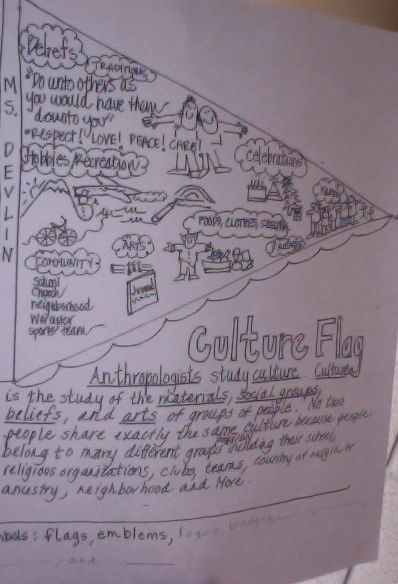
The Culture Flag activity is a chance for children to proudly display their culture related to this definition of culture:  Anthropologists study culture.  Culture is the study of the materials, social groups, beliefs, and arts of groups of people.  No two people share exactly the same culture because people belong to many different groups possibly including school, religion, club, team, country of origin, ancestry, neighborhood, city/town, state, country, continent, hemisphere and more.

I begin the lesson by reading People by Peter Spier to awaken their minds to the great diversity of people and cultures that inhabit Earth.  Then I hand out a definition sheet (see below) and we discuss the definition of culture and create an anchor chart of events, objects and experiences related to culture categories:  beliefs, traditions, ceremonies, hobbies/recreation, customs, community, symbols, language, arts, celebrations, heroes, food/clothing/shelter, values and family.

Then, the fun part, creating our flags.  I model the assignment with my own culture flag (see below). Then, students choose a triangular piece of colored paper. I give them a categories sheet (see below) so they can cut out the categories they want to represent on their flag.  After that students use photos, magazine cut-outs and other images to decorate their flag.  It may be a good idea to have students bring in a baggie of images and words related to their culture prior to the flag activity. We hang up the flags in the classroom to proudly display our varied, dynamic collective class culture.


This is a simple activity that creates a broad lens for students' understanding, respect and acceptance of each others' cultures, and the cultures we will learn about throughout the year.  I'm interested in learning about the ways you teach culture in your school--what activities and units support optimal education in this realm?  I look forward to reading about your ideas as well as the feedback you have for me related to this activity.

Related Lessons:
What's Your Culture: The History of Skin Shade
The Museum Project


Saturday, May 05, 2018

Embarking on Embedding the New Social Studies Standards

It's likely that the new MA Social Studies Standards will be adopted soon, and our team is looking at how we might integrate those standards into an already full curriculum.

Taking the lead from our superintendent's recent interview, we are exploring ways to teach these standards with depth, interaction, and application. Too often curriculum is diluted with a few minutes-a-day-approach, and rather than do this we're looking at ways to dive deeply into the curriculum by "dividing and conquering" which means we'll each become experts on parts of the curriculum.

As I think about this and think about a fifth grader's mindset, I think the idea of time travel might fit this focus well. What would happen is that every fifth grader would be able to time travel to a different period of history and during that time travel meet the important people, experience the places, and ask and respond to the integral questions related to that time period. Further, they will also have a chance to reflect on the impact that time period has had on life today, and hopefully experience the time period with a field study, expert visitors, and/or related project work.

In order to teach this well, we'll have to spend the first six weeks of the year introducing and discussing the principles related to this study as well as essential questions, tools, and perspectives. To do that we will likely include some or all of the following:
  • Introduce timelines and let students make their own time line beginning with their parents/guardians' birthdates and up until their future. This will help students to understand that their lives are impacted by events that come before them.
  • Introduce principles of government as we create democratic classrooms, write/review constitutions, and determine governing roles (jobs).
  • Review map skills, land forms, the history of people, the biology of skin shade, and more foundation principles and information. 
  • Consider the history and analysis of the phrase, "All men are created equal." Discuss how we might rephrase that to create equity in our school, classroom, and country so that everyone has equal opportunity, rights, privilege, and responsibility. 
And to enrich the study, we'll likely invite expert visitors such as the wonderful living history presentation of Ben Franklin we saw last year and visit related field study locations such as Sturbridge Village and/or a historic walking tour of Boston.

New curriculum always takes time.  We have a meeting Monday to discuss this, and to know ahead about what we'll do helps us to order related materials, research, and find time to meet and work together on this exciting goal. As our superintendent noted, for students to be responsible and active, citizens they need to have a solid civic foundation. The new Massachusetts' standards provide a rich resource and guide with which to build that foundation, and now it's our turn to figure out how to turn those standards into meaningful and memorable learning experiences.

Saturday, June 03, 2017

A Person I Honor is a Trump Supporter

Soon I will visit with a person I honor, and this person is a Trump supporter. This individual feels that Trump was sent to us from God to improve society. She prays for Trump, and is adamant about her support.

Last time I met with this individual, our conversation became heated as I do not support almost every policy and statement Trump makes and leads. Yet, I don't want that to happen again as I honor this person. She is a person of good character who has worked hard, loved her family, and cared for others with her talent and craft.

I wonder why this person is such a staunch supporter of Trump, a President whose efforts to date do not support this individual's lifestyle or needs. I can only think of the following reasons.

Trump represents the "Great White Hope" 
It's likely that this individual likes Trump because he is the same race as she is. It's possible that this person has deep seated racist views when it comes to diversity and skin shade. She watches a lot of television and probably sees mostly negative portrayals of people of color which has probably added to her potential underlying racist views and fears.

Trump has represented a strong stand on immigration
This individual's industry has faced considerable competition from new immigrants. Her own shop has noted less success in recent years due to this competition. This too could impact her support of Trump.

Trump represents an old America
I think this individual may long for days of old, the kind of days and routines that Trump speaks of when he talks of "Making America Great Again." This person lives a life that includes old time, traditional roles of women and men as well as old time prejudices too against new age freedoms for multiple people.

Trump represents Christianity
This person is religiously extremely conservative and values the idea that Christianity is the one religion. Trump has represented this viewpoint in action and inference.

Trump is Anti-Education
This individual did not have a positive education in her faith-based school. She was one of those students who came from a family that couldn't support her good education well, and she represented an alternate learning style--one of those students who is very bright, but a student for whom the traditional teaching methods did not work well. Hence, I imagine that she was a struggling student who was often demeaned for the fact that she couldn't grasp the learning quickly with traditional methods. Thus she has an anti-intellectual, anti-education attitude. Yet because she is so close to her faith, she still believes in faith-based schools. For these reasons, I think she may support Trump and his educational view.

Trump Values Traditional Ideas of Beauty
This individual values beauty in a traditional, "Ivanka Trump," way, hence she loves the way the women in Trump's life dress and look, and that's another reason why she values Trump.

Trump Says He Represents the Average Working Family
While Trump's policies and acts seem to represent the wealthy in our country, his speak says he represents the working family. This woman values that.

Conservative Radio and Television Supports Trump
This woman is an avid listener of conservative radio and television. She believes what she hears and supports Trump because of that.

I am much more of a fan of leadership that is altruistic, respectful of diversity, open minded, respectful, and honest. To me, Trump does not represent those values, yet for the person of whom I write, she values Trump as if he were a religious icon--it's perplexing for me, but makes me realize the following.

Trump's Support May Have Grown From the Fact That Many Americans Felt Disrespected and Unheard
I do think the woman I write of felt disrespected and unheard in the past, and her reaction to Trump tells me that we have to look for ways, in this country, to better respect all people of all classes, professions, neighborhoods, and lifestyles. This respect should include good services, support, and development of inclusive culture.

Media Has to Include More Positive Stories of Diverse Cultures
I often call the media the "bad news," because it highlights stories of despair, violence, and horror. Yet we know more good happens than bad. It's imperative that the media regularly include the positive stories of multiple cultural groups.Too often the only images of diversity people see are images that include violence and despair--this kind of reporting only leads to greater prejudice.

Strong Culture
As communities we have to talk about and make decisions related to what it means to develop a strong culture. This woman sees her values diminishing in the culture, values of strong families, healthy food, positive activity. Do our culture acts and values demonstrate a value for people's choice of religion, family time, multiple career paths, and more. To build a strong culture, we need to work to invite the voice and choice of all.

In all, I believe that this woman supports Trump because she wants to belong and feel valued. She's afraid of the changes that have occurred and has somewhat felt voiceless and choiceness. I want to think about how I can work towards valuing all people in our communities and working towards building strong culture. I think if we do this, we'll see less people easily swayed by marketeers like Trump who use strategies to convince people he will care for them, when it seems that he has no real interest or insight when it comes to truly caring for the average family or individual in the USA.

This is a messy post as I grapple with this woman's very different perspective than mine and get ready to spend time with this person, a person I honor in so many ways.


Sunday, April 10, 2016

Teaching Well: Cultural Proficiency

Note: As we begin school year 2017-2018, I revisited this post and added new updates in blue, and now that we're getting ready for school year 2018-2019, I've updated again in green. 

Our staff will devote this week's faculty meeting to cultural proficiency. Consultants will come to guide our work.

First, as I embark on this meeting, I am mindful of language and these articles:
I am also mindful of the number of constructs in our own work that impact what we do for each child.

Then I'm positively challenged by the conversation points, Benchmarks of a Culturally Proficient Teacher,  we'll discuss. I've added those points below and some initial response as I prepare for the meeting. There is so much we can do to better our work in this area, and Tuesday's conversation will certainly serve as a positive start. 
  • Study their students and spend time learning who they are.
    • How do we learn about our students?
    • What informal and formal assessments provide that knowledge?
    • Are there things we can do to better know our students and their families such as a different kind of orientation process at the start of the year, different use of lunch time/duties, roles, groups, and structures?
    • How might we survey students and families in this regard to forward our efforts.
2017-2018: Institute an orientation, intake process to get to know students and families better and build even better relationships. We started this new orientation process with a short pre-school orientation for a few students and a better intake survey. We will continue to follow the efforts we outlined to better this process. 

2018-2019: The orientation was mostly successful--we have a few logistics to figure out to improve what we did last year and hope we can iron those out to have an even more successful orientation this year. 
  • See their students as individuals AND members of different identity groups, and recognize that both influence their students ability to engage, connect and succeed with their academics.
    • How can we use heart maps, mind maps, self stories, and other introductory projects to begin to identify students' multiple identity groups and help educators with regard to creating and supporting collaboration and a sense of team in their classrooms. Our team is using the Selfie project, Culture Flags, Early Writing Efforts, Surveys, and related math projects to build knowledge of one another. Last year we forwarded the selfie project and this year we'll forward a timeline project since it fits our new social studies standards. We'll also continue many team building activities at the start of the year, make a team movie to celebrate our school team and share with families at curriculum night, and include other relationship building/get to know each other activities that connect with the curriculum. 
    • Explicit discussion of what culture is and work with that concept can help in this regard. We started this discussion by talking about the history of people, skin shade, history of learning, and opportunity lost/found. Soon students will engage in a specific activities related to culture. We will once again promote this successful teaching and discussion. 
    • Can we use a birthday slideshow where every child says their name correctly and we match a name and a face during our birthday recognition time at school assembly? We have not forwarded this idea yet, but I do think it's an important idea. Our school now does recognize each birthday person and each person says their own name. The visibility might be greater if the students said their name at the front of the assembly. 
    • In what other ways can we be sensitive to students' diversity in our schools? We have flags of many countries in our school. I would also like to improve the signage in our school related to this. This is a good question to ask students and see what ideas they have. 
2017-2018: Write a grant to support more inclusive growth mindset, SEL, and culturally proficient signage Our grant resource changed so we were unable to do this. Also building the "selfie" project to allow every child to introduce himself/herself and his/her interests through an audio/visual project at the start of the year. We're in the midst of this. This effort was successful. Talk about our "culture talk" and activities and think about how we are going to embed that in the start of the year efforts. We started this. This was successful, in fact some students turned it into their own anti-racism service learning project. Think about how we might further the "birthday name" project.This was changed for the better. 
  • Self reflect on their values, their culture and their teaching styles and recognize how these values impact how students engage and learn.
    • Do we spend enough time getting to know about the values of our students' cultures via conversations with students and family members. This is a good focus for upcoming parent-student-teacher conferences with the question, What do you value about education?Both fall and spring conferences included students. We deepened students reflections and roles at these conferences. We can continue to deepen this and make time for good conversation and relationship building with students. Helping out with the after school homework club is one avenue for this I want to explore. 
    • How do we best share knowledge amongst educators and the learning community so that we are sensitive to each other? We have had informal exchanges so far, and a lot of more formal exchanges are planned in the coming days. Our student service meetings are an excellent vehicle for this and will continue. 
    • Have we made the purposeful time to learn about the multiple cultures that make up our school community? This is a good question for a faculty meeting--perhaps I'll have a chance to support this. This is a good area for a start of the year mapping project--we could ask students what places in the world have meaning for them and why. By doing this in an open ended way we invite participation but don't force any one idea or obligatory share. 
    • Do we explicitly think about our own values and how those values impact our work with regard to success or lack of success for students? This is another good perspective as we listen carefully during the first conference of the year. Listening is imperative in this regard. 
    • How can we break this topic down for greater understanding and more targeted, successful, and positive work. This is another good question to discuss as an intimate and broader grade-level/school team. One big focus of the new social studies standards is to look at how the past affects the future--this might be a good place for this kind of conversation to grow. 
2017-2018 Think about ways to co-construct classroom goals and track progress with families and students on a regular basis. Greater communication will foster greater inclusivity and success. Work on vehicles for greater follow-up and response related to each student's goals, efforts, needs, and interests. 
  • Keep in mind that students come to us with a fully formed cultural background/knowledge and find ways to connect these strengths to "school" knowledge.
    • How can we specifically start the math year with survey work that identifies our many similarities and differences and create infographics to demonstrate this and discuss this.
    • How do we make space in our classroom to demonstrate what's important to each child and what they identify with?
    • How can we use early year infographics to inform future work, investigation, discussion, and collaboration?
    • How do we explicitly discuss this topic as teams, school, classes, etc. . .?
2017-2018 Build in more culturally proficient math activities including the ones listed above. We are beginning activities related to this in class this week with birthday/Math team activities. I want to follow Emdin's advice related to student question/expression bulletin boards too. Deepen the early year math activities to better include the standards while also building an opportunity for children to share their cultural backgrounds and knowledge.
  • Design and create instruction that knows, honors, acknowledges, and respects a student's culture. 
    • Where in the curriculum can we better design teaching/learning unit to be inclusive our the multiple cultures in our classroom? There will be a lot of opportunity to do this with the new social studies standards. 
    • What trends are occurring now that support this work?
    • What units specifically can we begin to rethink in this regard? Building this in with SS curriculum and deepening this with math/science curriculum. 
    • What are we doing already to meet this call, and what can we do more? We need to work on effort to bring in diverse voices to speak with students about topics related to the curriculum--we started to build this effort this year, but there is more we can do next year. 
    • Is there too much redundancy in what we do? Can we look at this systematically and make sure that we are covering a broad and deep range with regard to the teaching/learning we do in this regard?
    • How can we creatively use WPSF funds, professional learning time, RTI, and PLCs to support this work? It will be good to use the funds this year to support teaching the new SS standards via diverse voices and experiences. 
2017-2018 As a team use these questions to guide our development of the curriculum map, expert visitors, and field studies. These questions continue to be important, and good questions for a team discussion. 
  • Provide the emotional ego strength to challenge racist societal view of the competence and worthiness of students and their families. 
    • What is "ego strength?" What does this look like and how is it encouraged and developed? Discuss the issue of "fairness" early on in the year. Discuss the phrase "fair is not equal" and "All men are created equal" including the history of those phrases and how they should be interpreted today. Let this be a continual point of discussion throughout the year. 
    • How do you explicitly and respectfully acknowledge gaps in opportunity, freedom, recognition, wealth, and inclusion? Discuss what people need to succeed and how we can help each other get what they need to succeed. Foster self advocacy, voice, and choice in this regard. 
    • Flocabulary's "Week in Review" is a good catalyst for this kind of discussion in the intermediate grades. Students love these discussions. What other programs, films, activities, and efforts positively promote this kind of discussion? Make current events discussion a mainstay of the week routine, build in time for this. 
2017-2018: Again look carefully at these questions as we work on the curriculum map this summer. I want to discuss this point with the team, and decide how we will make this a regular part of our program. We had an initial discussion about prejudice and racism this week with the theme that no prejudice of any kind is allowed in our teaching/learning community. Build on what we did in 2017-2018 with the notes above. 
  • Recognize and challenge inequities in access and opportunity to programs, curriculum that encourages academic engagement and achievement.
    • How do we readily and sensitively deal with the inequity with regard to access to WIFI and technology?
    • How can we better schedule family nights, special events, and conferences so that all families are included? (We do this quite well now, but there is probably more room for growth)
    • How do we provide equitable access to extracurricular events and opportunities?
2017-2018 Institute a better plan for providing all students who need it with tech and WIFI. Institute the orientation, and think carefully about the questions above as we create the program map. We have invited families who do not have good computers to contact the principal to borrow a computer. We will also work to help families get affordable WIFI if needed. We started a sign-up for conferences early, carried out a curriculum introduction night, and added all curriculum presentation materials to the website. As far as extra-curricular events, the school system has provided transportation for this so we may want to think about how we can use that effectively.We will continue to be sensitive to this. The PTO was sensitive to this too. We are building in supplies and scheduling to support this effort in order to be inclusive with all of our programming and teaching/learning efforts. 
  • Constantly look for ways to differentiate their instruction so that it validates and invites more of the students' culture into the classroom.
    • Boaler's collaboration study is a good place to start with regard to this. The study demonstrated that by explicitly teaching collaborative skill and encouraging greater collaboration, students' collective academic performance improved.
    • What other studies out there provide us with avenues of differentiation that work with regard to leading all students to success?
2017-2018 Add six of Boalers floor-to-ceiling explorations into the fifth grade math curriculum. We started the year with lots of team building activities, and will continue those activities. I'd like to more explicitly teach collaboration and will design lessons to do that. We will continue to work towards this focus. 
  • Never give up on students or on their ability as an educator to teach every student.
    • How do we talk about students' learning? What language do we use?
    • Do we teach in ways that students like best or feel most comfortable with? Do we query students and families about this? 
    • How can we begin to look at new structures to support this work? Where do we find that our students who don't succeed fall down most, could it be that what we are asking for is not what is most important and sets students up for failure?
2017-2018 Update and embed lessons and initiatives included on the Learning Behaviors and Mindsets website to support this kind of work. We are beginning the year with explicit discussion about this. Last week we watched Boaler's TedTalk about Mathematical Mindset--students were attentive and responsive to the talk and its emphasis on growth mindset and brain-friendly learning. We are also observing our students with detail to find out where and why some students fall down. For example during a recent team activity, there were a few students who could not successfully work with their teams--I'll explore this more to figure out how I can help those students with team skills. Our early year emphases on learning mindsets and behaviors has been very positive. We will continue this. 
  • Support a growth mindset and empower students to see and understand themselves as successful learners.
    • How do we focus  progression and growth rather than current knowledge, content, and skill with regard to the way we teach, discuss student effort/success, and promote better learning mindsets and progress?
    • How can we provide greater choice with regard to learning paths and process?
    • Do we teach the brain science and growth mindset truths to children--the science that supports the fact that all children are capable of learning well?
We had a lesson based on the fact that students lead their learning--we will continue this emphasis on self advocacy, learning leadership, brain-friendly learning, and growth mindset throughout the year. This week a specialist and I are attending a conference that will help us to understand brain-friendly learning more We will continue to build on this by adding in Mystery Science's module on the brain so students understand how to support their learning in brain-friendly ways. 
  • Create a sense of family and caring in the service of academic engagement and achievement.
    • In what ways do we support positive relationships within and amongst the learning team?
    • How do you promote a positive, inclusive community within your classroom and school?
Our team created a great, positive video of all the students smiling as they engaged in learning. We shared the video with the learning team including colleagues and family members. We showed the video to students. We have focused on the fact that engagement and happiness matters to good learning. As a teaching team, we will continue to build this emphasis. We emphasized team all year last year and we will continue to do that throughout the year ahead. 
  • Acknowledge that this is a work in progress and it will take time to reach all the benchmarks.
    • How do we take this work seriously and give it thoughtful time? Perhaps this could becomes a once-a-month focus of PLC work and endeavor?
    • How do we readily share the ideas and practice that work with each other on a regular basis? Perhaps we could have a 10-minute share at the start of the faculty meeting that poses questions in this regard and shares positive actions and stories?
I'll ask my teammates if they would like to make this our shared goal this year, and if they would like to continue the good work we did last year with it. I'll also share this post with the school administrator since he initiated this discussion by inviting the IDEAS consultants in who shared these attributes with us. We made good progress in this arena this year. Next year I plan to work more closely with SEL competencies to develop each child's ability to manage and lead their social emotional learning and strengths. 

We can't just talk about this issue in isolation as the educators. We have to broaden this issue to the entire learning community by providing time to talk with family members, students, and community members as to how we can do this better. All of our students will be living, learning, and working in diverse environments. The positive work we do in this regard will well prepare them for their future. Fortunately we have a very diverse student body and we continually address issues of cultural proficiency in our school. Programming in many areas has improved too, however there is still room to think deeply about our programming and how we might do an even better job in this realm.