I want to revisit the "Hosting Conversations" research and efforts as I think ahead about the work we will do as educators during PLCs and other collaborative endeavor to teach students well.
I am thinking that this topic may arise at the Malden EdCamp since Abby Dick was part of the summer learning related to this.
I am also thinking that I may be able to revisit this at Educon too.
In the meantime, I'll review my notes and handouts soon to begin to implement this valuable learning and research into real time efforts to teach children well. I welcome your thoughts.
Sunday, September 11, 2016
Standards-Based World: How Do We Teach Students One or More Years "Behind"?
 |
| A super guide for teaching math well! |
To answer my own question, I will create Boaler's "floor to ceiling" learning experiences that have what I've always called the 1-2-3 approach where 1 is review, 2 is grade level, and 3 is enrichment. I always open all levels to all students. Willingham in his book, Why Don't Students Like School, affirms the opportunity that exists when students review material that they "know" since there's always more depth to be gained by that review. I know that to be true because I've taught similar standards for years and each time I teach the standards anew I make more connections and learn more.
So with this 1-2-3 or "floor-to-ceiling" approach what's important and how does it work?
It works like this. Students enter the experience at level 1 with a review. For some the review will be quick and pointed, and for others the review stage will represent new learning. Level two is the grade-level norm or standard, and the place that we hope most students will master with the support of educators, classmates, and family members. The third level is enrichment and it's open to all. I find that when I open the enrichment level to all, it's amazing to see who reaches since it's never just those students you'd expect to reach. Often a child who struggles in one area of math may reach in another. That's why I'm not a fan of permanent grouping especially in the early years. I like the flexible grouping we use during RTI related to specific skills, knowledge, and concept goals.
 |
| Another great book when it comes to matching learning with how the brain works. |
- Introduce everyone to the big idea in an intriguing way.
- Scaffold the experience so there are levels 1-2-3 and all levels are open to all.
- Leave the experience "loose-tight" with plenty of room for student choice and voice.
- Make time and space for discussion, share, and response.
- Use teamwork when possible and be strategic about how you create groups. Use a variety of group types so that students are working with like-partners, unlike-partners, mixed-ability groups, like-ability groups, interest-based groups, and more. As you employ various types of grouping, observe which groups inspire, engage, motivate, and forward student learning.
- Use strengths/interest-based content and approaches as much as possibly and introduce many ways to learn and let students try out all the various ways to learn too.
We can't predict how a child one or more years away from the curriculum grade-level standards will learn and grow. Sometimes when a learning experience is truly engaging, a child will leap ahead and demonstrate significant growth. Sometimes students will do this even if the experience isn't engaging as they reach a point of cognitive shift that helps them to merge and consolidate ideas with greater ease and strength.
There are also times when a student remains stuck with a concept, knowledge, or skill. Give it the good try in multiple ways, and then take a break and return to that learning point later.
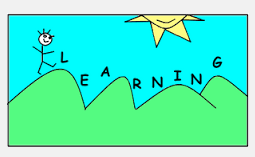 |
| Learning is not linear. |
How do you teach students who are behind when it comes to standards learning? Please share as I want to broaden my understanding of this as much as possible as I now we can grow our expertise in this area.

Education Collaboration: Research and Reality
A colleague from a school system other than mine called to tell me how an administrator asked her to implement a research-based program in her classroom. My colleague who has been teaching school for more than a quarter of a century was able to quickly think about the command and recognize that while it represents good research it doesn't represent the reality of her current teaching/learning situation--there needs to be a lot of leg work done before the administrator's command could be rightfully implemented in a way to serve all students well.
Too often administrators jump to implement research without talking about the research and reality with the educators they manage. Too often this kind of mismatch of decree and reality creates lost opportunity for what could really happen to move schools forward.
In my colleague's situation, there are big questions left unanswered. The biggest question that exists in her school and system is "How are we going to serve our students well including our many students who face unimaginable social and economic circumstances?" Daily this colleague relays stories to me that remind me of Dicken's tales, tales I never thought would come to life in my lifetime as a citizen of the United States.
In the school I write about, there are many issues that exist, issues that stand as obstacles to good work and teaching. Issues that include the following:
Too often administrators jump to implement research without talking about the research and reality with the educators they manage. Too often this kind of mismatch of decree and reality creates lost opportunity for what could really happen to move schools forward.
In my colleague's situation, there are big questions left unanswered. The biggest question that exists in her school and system is "How are we going to serve our students well including our many students who face unimaginable social and economic circumstances?" Daily this colleague relays stories to me that remind me of Dicken's tales, tales I never thought would come to life in my lifetime as a citizen of the United States.
In the school I write about, there are many issues that exist, issues that stand as obstacles to good work and teaching. Issues that include the following:
- Educators who work with the students are rarely to never consulted about new programming or needs. Hence they go into classrooms daily that represent vast needs with little to no voice or choice. Hence good, quality innovation and new ideas are lacking to create a better learning situation for all those children, the same children who will grow up to be difficult citizens simply because they are not getting what they need at a young age.
- It seems like funding is not spent well in that system or that they truly don't have the funds they need to support the students. Computers hardly exist, innovative programming is lacking, building updates and safe/healthy schools are challenged--I'd love to look at that budget.
- Administrators are often hired that have far less experience than the teachers who teach the students, thus the mismatch story and many more.
- Administrative turnover is great so there is little consistency in leadership which is also an issue.
Fortunately, the system that I work in has not faced the issues that my colleague's school faces. I ache for the students in her school because I know that my students are getting a better program. It's not because the teachers in her school are less qualified or committed, but instead it's because they have almost no voice and choice over policy and practice which leaves those teachers and their students un-empowered. Once again this situation points us in the direction of greater support for new and powerful administrative models in schools--models that empower both the administrators and the educators because that empowerment trickles down to students which is integral to teaching/learning success.
I too am preparing for a number of meetings with managers and administrators--people who have a lot of authority over the work I do each day with students. As I think ahead to those meetings, I want to be cognizant of the following questions and information:
- What is your role? Understanding a manager or administrator's role is important. Often new managers and administrators are appointed, but no one really understands their role fully which creates lost opportunity.
- What are your expectations? I want to know what these administrators and managers expect of me?
- What is your vision for students' experience of school and learning? What rationale supports your vision--why are you choosing what your are choosing?
- What goals hold greatest priority and why? I want to know what these administrators and managers are prioritizing and why.
I want to work in concert with my colleagues, family members, students, and administrators and managers. I know there is great strength when we come together to work for the welfare of our students. Good conversations, understanding of roles, and prioritizing efforts can empower this work.
With regard to the story that started this post, it's best that we all steer clear of directives that are unrealistic even if they are research based. In the situation I relay, the best result would be for the administrator to create strong collaborative teams in that school, and then make the time to sit down with those teams to discuss the use of time and the needs of students. I know that this colleague is surrounded by dedicated professionals, and I know that their collective strength, intelligence, and experience has been lost in their current voiceless and choice-less school model. There is much opportunity and potential possible in that community, potential and possibility lost due to an administrative model that replicates old time factory models rather than new age knowledge models. I hope every administrator and manager reads this post and then re-looks at the way they are empowering and maximizing the intelligence, creativity, strength, and collaboration of their learning community including students, family members, educators, staff members, citizens, and administration.
Friday, September 09, 2016
Friday Musings: September 9, 2016
 |
| Coming Soon |
Now since we have a computer for every student, the learning opportunities are terrific. It's much easier to scaffold, differentiate, and target learning when you have one-to-one access. With the computers students took math knowledge, attitude, and behavior surveys using Google forms. The survey data will help me to teach students well as I'll have a better sense of who knows what and how students feel and act towards math.
We changed desks a lot as we tried to set up the room to accommodate the different kinds of teaching such as marshmallow-spaghetti team structures, independent work, video viewing, and choice time. The room will continue to morph over time as we teach and learn in different ways. Next week we'll focus on The Global Cardboard Challenge project and with that we'll have a chance to practice the design process, teamwork, and lots of creativity and critical thinking.
Hopefully this weekend I'll have a chance to review students' first assignments and offer feedback too as a goal I've made for myself this year is to offer meaningful feedback on a regular basis. Onward.
Wednesday, September 07, 2016
Time for Assessment and Goal Setting
We'll continue to work on team building, routines, and community, and we'll add assessment too. Students will take a number of assessments that demonstrate their attitudes, skills, concept, and knowledge. Educators will use the assessments to craft programs with and for students that are engaging, relevant, and meaningful.
Tomorrow students will take an attitudinal survey and the next day they'll take a knowledge survey. Both surveys will give me good information about who I am teaching and what they need and are looking for. Further I'll ask students to write a math biography to let me know about their math learning, attitudes, interests, and needs.
By the last week in October when we sit down with family members we'll have a comprehensive view of students interest/need profile which will help family members, educators, and students to set goals.
In the meantime, as mentioned above we'll continue a focus on team building, projects, and many other learning experiences too. The year is off to a great start.
Tomorrow students will take an attitudinal survey and the next day they'll take a knowledge survey. Both surveys will give me good information about who I am teaching and what they need and are looking for. Further I'll ask students to write a math biography to let me know about their math learning, attitudes, interests, and needs.
By the last week in October when we sit down with family members we'll have a comprehensive view of students interest/need profile which will help family members, educators, and students to set goals.
In the meantime, as mentioned above we'll continue a focus on team building, projects, and many other learning experiences too. The year is off to a great start.
Subscribe to:
Posts (Atom)