Sunday, October 05, 2014

Buddy Time: Photos

My own sons are convenient models for classroom examples :)
While working late one afternoon, a kindergartner and her parent walked into my 5th grade classroom. The kindergartner exclaimed to her mom with a smile, "This is my buddy's classroom."
     "What's your buddy's name," the mom replied.
     "I can't remember," the kindergarten student sighed.

That event prompted this week's Buddy Activity: Photos and Pattern Frames.

Fifth graders will import a table photo frame into KidPix before we arrive at the buddy's nice, big, bright classroom.

Then they'll "hide KidPix" and bring up PhotoBooth.

When we get to the buddy classroom, they'll PhotoBooth a wonderful picture of themselves with their buddy--both looking proud (not silly).

Then they'll drag the photo to the desk top, and import into the photo frame.

After that they'll add the decorations including the following:
  • A pattern border that includes a sequence of 5 pics of what they both enjoy. They'll repeat that sequence 4 times around the border.
  • Colors and design around the photo.
  • Colors and design around the pattern.
  • Their names and "2014."
Then they'll edit their work with a teacher, print two copies--one for the buddy to bring home, and one to hang up outside our classrooms (which are next door to each other).

After that, they'll have some time to make some silly, fun pictures using KidPix. The fifth graders will be the KidPix tutors for the kindergartners.  

Buddy Time: Patterns and Proportional Reasoning

The fifth graders are working on proportional reasoning, and the kindergartners are studying patterns. So for an upcoming buddy time, we'll apply both as we make straw necklaces.

First, fifth graders will figure out how to cut straw pieces that equal 1/8, 1/4, and 1/2 of a straw. Then they'll cut lots of pieces and store them in baggies and label.

After that, they'll see how students can use a pattern "map" or chart to guide pattern making.  I'll give students a table template like the one below, and students will make a pattern first with straws, then with symbolic letters, and after that with colors to represent the size and color of each straw piece. I'll also ask them to figure out what the 50th 100th term of their pattern would be if they were to continue the sequence.

Next, fifth graders will string their own necklaces, and describe their pattern in words using the words sequence, term, repeat, 1/4, 1/2, 1/8.

When we meet with buddies, fifth graders will wear their necklaces and bring the pattern maps and baggies full of straw pieces.

Buddies will review vocabulary and math skill by first asking the kindergartners what they notice about the straw pieces in each bag? Then the fifth graders will say that we are going to make a sequence of shapes and colors with four or five pieces, which pieces do you want to use?

On the first row of the pattern map, the buddy and fifth grader will make their first sequence.

Then the fifth grader will say, can you repeat that again on the next line? They'll make the next line, then repeat two more times. After that they'll string the straw-beads in order from one sequence to the next onto the yarn and tie.

Once the necklace is done, they'll add the letters S(small), M(medium), B(big to the map) to represent the size of each term in the pattern. Then they'll color the boxes with the pattern colors.  Fifth graders will help buddies to "read" the pattern once they are done, reading colors first, then size letters.  If there's extra time, the kindergartners and buddies can design other patterns using the pattern maps.


Beginning a Unit with Big Concepts: Proportional Reasoning

As I teach, I’m wondering about the role that overarching concept plays in the teaching/learning choreography.


For example, once I understood what made up a system, I could apply that concept to learning about all systems with central questions:
  • What is the main function of the system?
  • What are the parts?
  • Where are the parts located?
  • How do those parts function together?
  • What are the critical factors of this system?


Now that students are beginning their unit on place value, I’m thinking more about proportional reasoning.


I’ll start the unit with the illustration below and ask, What do you see?
Big and Little Mixed Rectangles.jpg


I imagine students will say some or all of the following:
  • I see rectangles.
  • I see small, medium, and big rectangles.
  • I see __ # of rectangles.
  • I see a design.


Then I’ll remind them of the recent lesson where we tried to describe locations on an aerial map of the playground. The descriptions were vague using words like behind, past, next to instead of precise locations. Then when we placed the coordinate grid on top, it was much easier to be precise.


What can we do to be more precise about describing this picture?  Then I imagine students will say, “put the shapes in groups,” “order from smallest to largest,” and “measure.”


Then I’ll say, “Yes, similar to the use of a coordinate grid, mathematicians have come up with systems of measurement--ways that tell us how big or how little an object is. These systems help us to compare and combine values with precision.” When is it helpful to have exact measurements and/or values? Again students will offer all kinds of examples which we’ll list.


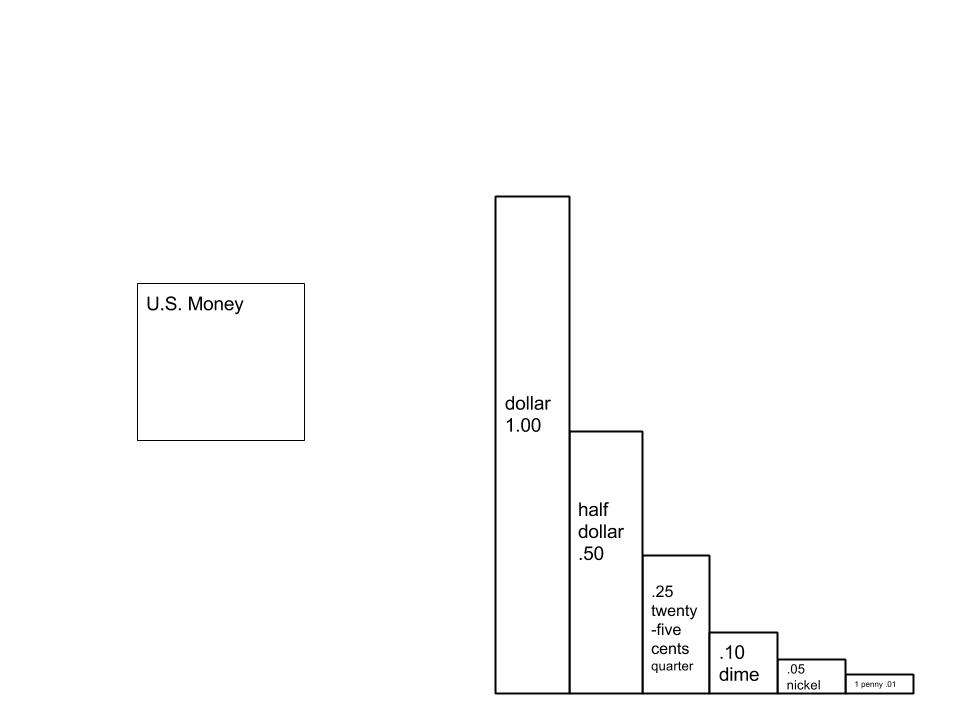
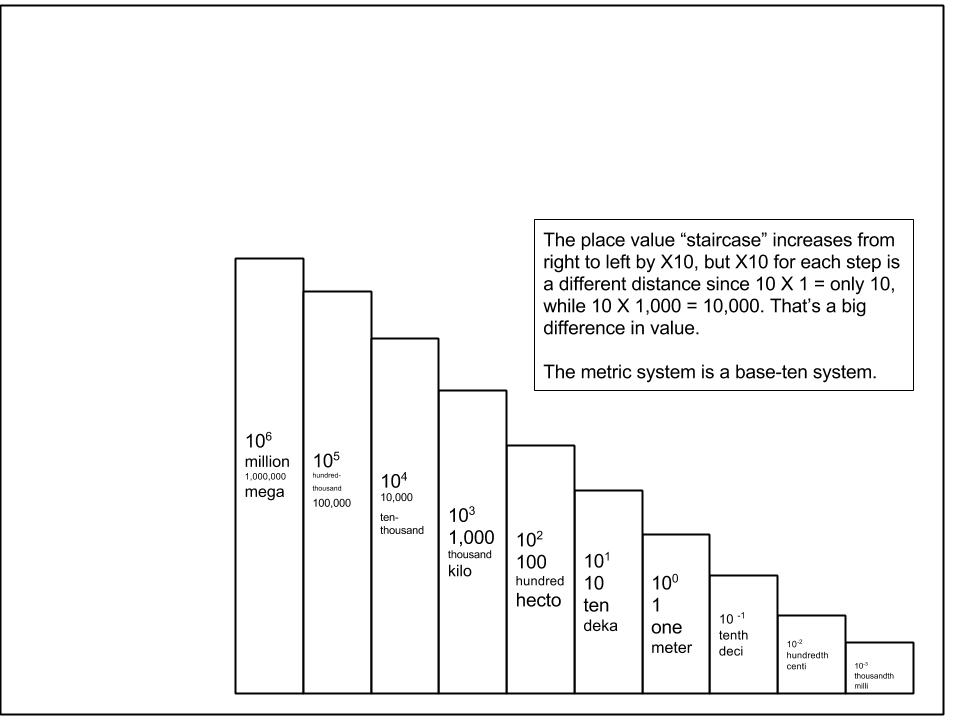
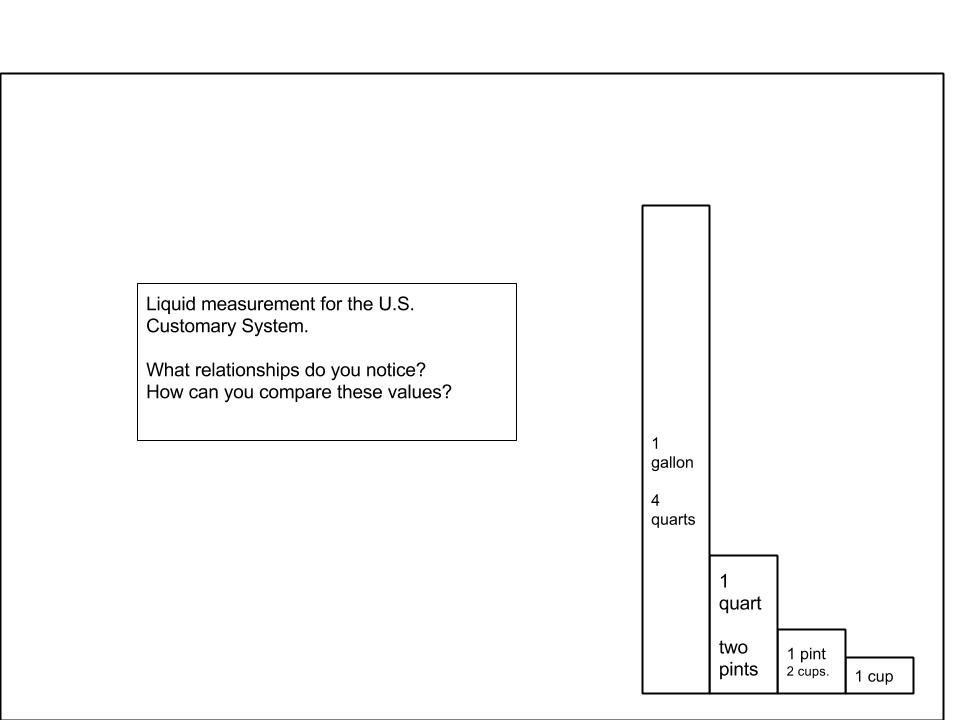
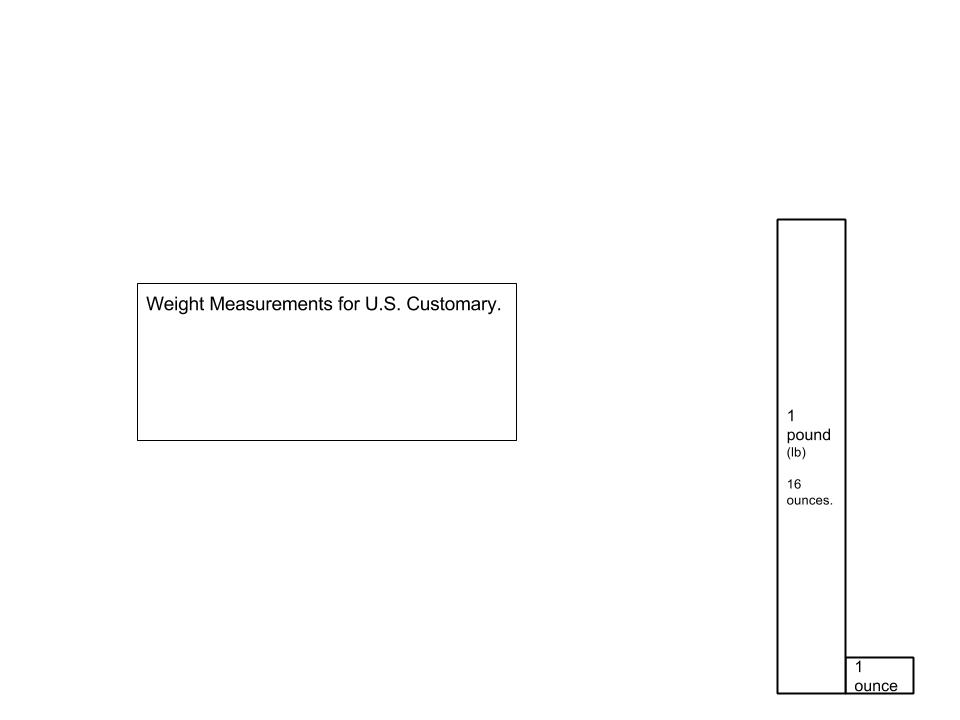
Then I’ll show them the models below. I’ll explain that I made these models with estimation, not precise measurement. I’ll ask again what they notice about the models? What is the same, and what is different? What relationships do they see?  


We’ll spend some time talking about the concept of “big and little,” and the many ways to communicate that using precise numbers and measurements. After that, we’ll make some models that are precise and hang them around the school to remind everyone about the accurate proportional measurements related to time, money, measurement, and place value. I can imagine that this will build a strong foundation for our upcoming study of place value. Do you agree?


Models:
money proportions.jpgBase Ten System:Metric.jpg
Liquid Measurements U.S. Customary.jpg


U.S. Customary Measurement .jpg

weight measurements .jpg

Saturday, October 04, 2014

The Fifth Grade Year Continues: October Focus

In a true learning/teaching team, the students play a big role in moving the learning journey forward, and that's certainly the case in my class.

My highly creative team of 44 math/science students are always problem solving about what to create next, and this is an important consideration as I look at the month ahead. I also have the responsibility to meet the standards and personalize the program so that every child makes progress.

I find that I have to keep revisiting the focus areas so that we don't veer off the path too far and meet the objectives set. As I mention often and will continue to do so, teaching the curriculum for a first year is a busy endeavor, one that takes this kind of repetition and attention.

The focus areas continue to be those listed below:

1. Creativity and Creation: The STEAM center will continue to evolve. I wish I could snap my fingers and a miniature IDEO would appear, but that's not the case so this is going to be a work-in-progress as we arrange materials in just right ways and containers to support the young innovators.

2. Math Program: We're moving through the standards with depth using a blended model including paper/pencil, tech, problem solving, math talk, videos, small group, independent work and more. The program includes lots of rich model making and real world connections. We'll complete our algebraic thinking first unit this week, and move to place value next week. Step-by-step we'll meet the goals.

3. Science: The life science unit continues. The landscape models are complete, and many are on display in the school. We visited our "wilderness" area for the first time, and reviewed the unit vocabulary. Now we'll dig into each life science standard concept with a blended approach including focused attention on the concept, skill, and knowledge using video, word/image notes, and vocabulary. Then we'll apply that learning to an outdoor activity in our nature plot. This week we'll focus on the attributes of living things and variance.

4. Social Competency: Our Learning to Learn studies are the base of our social competency work. I'm finding that these lessons are easily embedded into math and science lessons as we "learn to learn" and collaborate with one another.

5. Read Aloud: The students really enjoy books, and the read aloud is bringing the class together. Right now we're reading Wonder which is a great fifth grade book. During read aloud we focus on story elements as well as multiple connections to social competency, real life, and curriculum content.

6. STEAM Stars: We're still digging into the story of George Washington Carver's life. There's so much to know about Carver. Plus we're using this study to learn how multiple resources and "brain frames" can shed important light on an individual's life in rich and deep ways. So far, students have watched a video, listened to multiple stories, and reflected on his life in writing. I want to share some poetry about Carver and complete a final discussion and written analysis of the study before we move on to the study of many naturalists.

7. Buddies: The Friday afternoon buddy time is serving to establish strong kindergarten-fifth grade relationships. The 5th graders look forward to this learning/teaching time this week--a time that is both educational and heart-warming.

In addition to this rich classroom program, students are also engaged in terrific English language arts reading, vocabulary, and writing activities, art class, music class, instrumental or music workshop, physical education, tech class, and library each week.

The potent pieces of a fine education are there, and now it's my job as an educator to weave the work together so that every child learns with confidence, engagement, and success.  Onward.

Prepare for the Global Cardboard Challenge

On Monday, the class will participate in the Global Cardboard Challenge.

In hindsight, I wish I had reserved a larger space such as the school cafeteria for this event, but we'll do that next time.

For now, 44 students, twenty-two at a time will create with boxes, recyclables, art supplies, and other materials in the classroom.

During the challenge, I'll assist by helping students find the supplies they need; making sure that the use of tools is safe, taking photos, and videotaping students explaining their creative actions.

I expect that this activity will spread out through the week as students put the finishing touches on their work--then the following week, we'll make time to share the creations with others near and far. Stay tuned.