Wednesday, August 10, 2011

Teaching Mistakes--Do Not Repeat!

After 25 years of teaching, I've made my fair share of mistakes.  The trouble with teaching mistakes is that they affect children, the very people we are there to serve. Most of my mistakes as an educator have been related to unrealistic expectations for myself and others.  High expectations are good, while unrealistic ones only lead to frustration and error. Some mistakes stand out, and I hope by sharing my experiences with you, particularly those of you who are new teachers, I'll prevent you from making similar errors.  Here goes:
  1. When a situation becomes challenging, ask a question or take time out to reflect.  If a parent, colleague, or administrator confronts you and you feel pressure, don't be afraid to ask a clarifying question or simply state, "I need to think about that, can we meet again to discuss it."  No one has all the answers, and with respectful dialogue most situations end with a comfortable compromise.
  2. Never raise your voice.  Most of us have done that, and it's useless except in the rare occasion when a true emergency is at hand and a strong voice is needed to alert others.  Again, if you feel emotions rising, take a break.
  3. Don't do it alone.  During challenging discussions and events, enlist the support of an administrator, union representative, colleague or other support person.  Often, two minds are better than one when it comes to complex situations.  Plus, your colleague can help you to understand the situation with greater clarity.
  4. Don't blame or accuse students.  Children will make mistakes and act inappropriately.  The best teachers always make the time to have a private talk with a child when he/she errs. It's best to start with the question, "Why did that happen?"  Then follow up with a discussion, steps for the future and possibly a logical consequence.  Again, seek the help of an administrator, colleague, guidance counselor or other support personnel when needed.
  5. You're not superman or superwoman.  As much as you'd like to do it all for every child in every situation, at times that will be impossible.  Don't pressure yourself to be all things, instead prioritize and choose the most essential items and do a good job with those starting with building a caring, cooperative classroom.  Don't work more, work smarter.
  6. Take your time.  Current standards can send teachers into a flurry as they try to complete it all.  Studies show that it's actually impossible to meet all the standards set in some situations.  A too hurried pace makes the entire class uncomfortable, and heightens the potential for error.
  7. Respect.  Sometimes with the hurried pace and multiple demands of school life, it can be difficult to understand the roles, needs and challenges students and colleagues face.  Use respect at all times.  Also, if you're faced with disrespect from colleagues, parents or students, enlist the support of trusted colleagues and/or administrators.
  8. Make all decisions with the lens of what's best for children.  Educators make many decisions each day.  Taking the time to make your decisions with the lens of what's best for children will foster professional strength, ethics and effort.
Will I continue to make mistakes?  Definitely.  Education always presents new challenges and complexities.  No two years are alike and there's always more to learn.  Keeping the focus of kindness and respect for all first will prevent the big mistakes, the kind that hurt others.  

No one likes to admit they've erred, but hopefully these tips will help you to have a successful year.  If you have a mistake you'd like to share in an effort to prevent others from repeating it, please do.  We all learn from our mistakes.

Standardized Tests?

The current education debates often result in a discussion of to test or not to test. Having just received a host of scores related to last year's students' progress, I'm inspired to write about my thoughts related to testing.

I consider myself an advocate of streamlined, standardized tests that are used to improve academic programs and conditions for excellence.  I am not in favor of utilizing standardized tests to punish or reward teachers and schools, instead I believe that tests should lead school leaders and teachers alike to reflection and action that continue to develop and build their school's service delivery for all students.

As a teacher in Massachusetts, I've worked with standardized tests for many years. There are both advantages and disadvantages to these tests.  The advantages include the following:
  • The tests define essential knowledge standards thus providing common language and academic goals for educators, leaders, students, and parents across the State when it comes to developing optimal programs.
  • All students are tested and their scores are noted so whether you're a child with tremendous socio-economic support or one with very little, your scores are reported and your school is held accountable for your progress.  Prior to these tests, a child who couldn't read could slip through without note.
  • Utilizing the scores as a means of analysis and reflection can help schools to build better academic programs to meet all students' needs.
The disadvantages to the tests include:
  • Rather than seen as a means to improvement, the tests have been utilized to foster competition, and the competition, in turn, has turned many schools into "testing factories" rather than educational centers that service the whole child.
  • The standards are great in breadth, thus making coverage and acquisition often impossible leaving little room for meaningful, community-based/related education, and responsive student-centered learning. (Note that the PARCC tests remedy this to a degree.)
  • Socio-economic factors have been dismissed and ignored when year after year the schools with the best scores are the wealthiest, and schools with the lowest scores generally face dramatic socio-economic issues.
  • The tests only assess a narrow dimension of student learning and learning styles when in reality, many of our most successful adults demonstrate skill and mastery in areas not included on standardized tests such as social skills, drive/passion, athletic endeavor, artistic skills, and more. The narrow scope of tests also deters schools from embracing in-depth, project-based learning that motivates students and develops noted 21st century/lifelong learning skills: creativity, collaboration, communication, critical thinking, citizenship, and character as well as my addition, community--skills which greatly impact our future.
  • Conditions for excellence such as student confidence, basic needs (sufficient nutrition, health care (including dental care), shelter, clothing), optimal learning facilities/playgrounds, and social-emotional factors are not assessed yet we all know those factors impact academic success greatly.
So, the issue is not to test or not to test, instead the issue is what makes a successful school and/or academic program. We can move closer to this goal with the following actions:
  1. Establish a broad criteria for school/student excellence for all schools. Then utilize the criteria to better serve schools rather than punishing them. Criteria could include the following:
    • Acquisition of essential knowledge skills for all students as determined by common core guiding principles and streamlined standardized tests.
    • Optimal learning environments that are safe, clean, tech-savvy, inspiring, and big enough to accommodate all students with care and respect.
    • Acquisition of 21st century/lifelong learning skills through meaningful, project based exploration.
    • Motivated, confident, inspired students whose social, physical, academic, and emotional needs are noted, understood, and nurtured.
    • Dedicated, professional skilled staff and administration.
  2. Utilize test scores and criteria evaluations to determine where the needs and questions are.  Work closely with universities and other research centers to refine and communicate criteria for excellence, common core standards, and instructional practices. Create opportunities for shared development and knowledge throughout the country, and note successes regularly.
  3. Continue to analyze the role of schools and education with respect to our country's and world's future.  What's important to Americans as they consider the role of education for all children and citizens?
  4. Develop the education profession by establishing high standards, optimal preservice academic programs, adequate pay, and professional working conditions.
To test or not to test is not the issue.  Formative testing and streamlined, standardized testing, when used appropriately, help us to develop and improve school programs, but it's only one piece of the complex, ever-changing landscape of schools and academic performance.  I'm interested in your thoughts on this topic.  Please don't hestitate to comment.

Tuesday, August 09, 2011

Classroom Set-Up

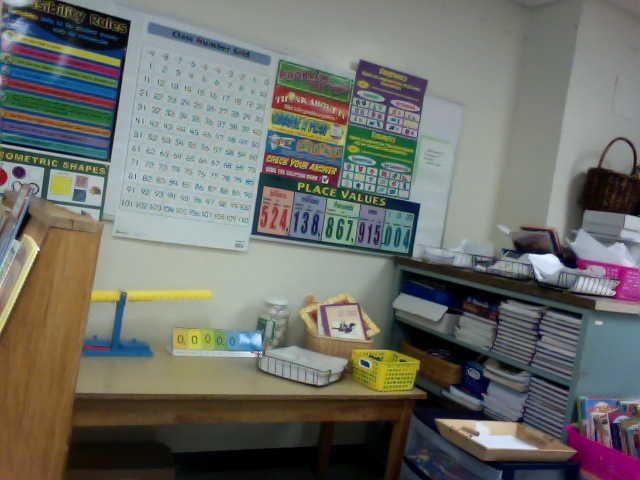
While my son's at camp today, I'm going to go into school and start the classroom set-up process.  "Everything in its place and a place for everything" will guide my work.  Classroom teachers deal with lots and lots of materials so it's essential that those materials are well organized in the confines of the classroom space.  Starting with a plan helps.

Classroom Library
Over the years, my classroom library has expanded to hundreds of beloved books.  Many of the books came from my own children's collections, and others have been bought or donated.  I will organize the books into the following sections:
  • Nonfiction: Arranged by topic.
  • Picture Books: Some will be added to unit boxes, others to author study bins and still more will be available for everyday reading.
  • Poetry: We start the year with our poetry unit so those will be on display.
  • Chapter Books: Arranged in bins by author and/or topic.
  • Reference Books: Sorted by topic and available in topic centers around the room.
  • Reference Charts: Related to comprehension strategies, literary genres, story elements.
  • Comfy Chairs: Some nice chairs that welcome students to this quiet area to read and think.


Topic Centers
I'll arrange materials related to specific topics in centers around the room.
  • Math Center
    • Vocabulary Board
    • Reference Charts
    • Computation Games/Flash Cards/Paper-Pencil Practice (in plastic file drawers)
    • Manipulatives
    • Reference Books/Related Picture Books

  • Writing Center
    • Dictionaries, Thesauri, Writing Reference Books
    • Paper (Located in wire paper baskets)
    • Reference Charts/Craft Vocabulary Board
    • Classroom computer storage area.


  • Theme Center: This area will be the focus area for current curriculum theme.
    • Book shelf to display books related to theme.
    • Table to show case theme-related items.
    • Bulletin board(s) to display student work, vocabulary and reference charts

  • Teacher Center
    • Plastic file drawers for personal items/professional papers.
    • Table for student edits.
    • Wooden shelves for reference books.
    • Supply corner: Unit containers, curriculum related books/materials stored in back corner.

  • Presentation Place
    • Document camera
    • Display boards for posters, images, charts, schedule.
    • Interactive White Board


  • Student Organization (specific spaces marked w/#s, each student is assigned a #)
    • Student mailboxes
    • Class News Board
    • Project Cubbies
    • Student desks - arranged in amphitheater arrangement (rows of three or four) facing display space.
    • Student project work display board(s).
    • Hooks for backpacks, coats and boots.
  • Meeting Place
    • An area of the room will be set aside for open circle and read aloud meetings--a space separate from the desk area.  
Welcome/Start-of-Year Displays
  • What's Your Culture? Bulletin Board:  Display space for culture flags, culture concept sentence strips.
  • Student-Created/Purchased Anchor Charts: Related to Patterns of Thought/Action for Lifelong Learning.
  • Birthday Graph: Students create their own "birthday cake" symbol and place it on the birthday pictograph.
  • Biodiversity/Animal Adaptation Center


Every teacher knows that the classroom set-up is a time-consuming task, and there's not one way to do it.  We've got a couple of prep days before the school year begins, but those are usually consumed by scheduling, planning and prep meetings.  

Once I finish the process, I'll take a few pictures and add them to this post. In the meantime, please comment about what's important to you about your classroom set up and organization.  Creating an optimal space for student learning is essential to doing the job well, and every teacher utilizes a number of effective strategies to personalize and optimize this effort.


Tuesday, August 02, 2011

Teaching Well is About Balance

Teaching well is about balance.  Easier said than done, but a good teacher, like a good parent, has a sense of balance when it comes to what matters. As I begin to think about the school year ahead, I'm beginning to focus on what matters and what the balance needs to be to best teach my students.

Health
Good teachers need to be healthy.  It's important to be there each morning energized and ready to meet the needs of many students, colleagues, parents, administrators and others.  The contact time is intense and the pace amazing.  Hence, making the time to be healthy is critical.  Healthy habits will vary from teacher to teacher, but those that come to school each day with zest generally exercise, eat well and get plenty of sleep.

Leisure
You've heard the phrase, "All work and no play makes Jack a dull boy," well the same is true for teachers, "All work and no play makes teachers (and the classroom) dull."  Hence, make time to recreate, and plan some fun getaways during the school year to refresh and renew.  The teaching job is limitless, and it's up to you to plan some time for fun and life outside of school.

Life Long Learning
Similar to leisure, if a teacher isn't taking part in developing his or her own learning, then he/she has little to bring to the classroom.  The world is constantly evolving and it's up to teachers to make time to grow intellectually throughout the year.  Twitter and educational blogs open multiple doors for educators with regard to professional growth.  It's a great medium because it fits well into our busy schedules and the balance of home and family.  Other optimal learning opportunities include system-wide book clubs, professional courses, and conferences. Taking the time to research upcoming conferences in your field or area of interest during the summer gives you the lead time to make the professional request and plans so that you can attend the event.

Routines and Patterns
Creating optimal routines and patterns prior to the school year supports balance.  Our family creates a weekly schedule and we try to stick to it as much as possible.  My husband and I choose nights that are "ours" so if we want to schedule a late meeting, meet a friend or take a course, we generally try to schedule it for our "night."  The same is true for the classroom; an optimal routine helps with planning so you meet all the curriculum standards, provide each child with the time they deserve, coordinate with other professionals in the building and employ the teaching practices you've deemed essential.  It's worth securing steady child care, after school activities and other routine events for your own children as it enables you to do your job well with the security of knowing that your children are in good hands.

Relationships
Teaching, particularly when you have a family, can be challenging with regard to your relationships.  As stated earlier, it's an endless, demanding job that includes tremendous contact with a wide group of people each day.  Hence, making time for relationships can be difficult.  Making a plan as to when and how you'll meet up with friends and relatives throughout the year helps.  Also planning events outside of your house such as a shared hike, day at the beach, or bike ride can give you time to stay healthy and enjoy friends too.  Scheduling realistic dates, such as the third Wednesday of every month, can help you to plan your energy and efforts, so you're ready for a enjoyable times with those you care about.

Collegiality
Sometimes, since the classroom can be demanding, you feel like you just don't have the time for the collegial aspects of your job.  That's a mistake. Research shows that when we work collaboratively, we do a better job.  Also, getting involved in new initiatives and endeavors with colleagues is energizing and in the end, makes you more targeted and efficient in the classroom.

A Positive Attitude
The saying goes, "If you're not part of the solution, then you're part of the problem."  It's easy to get drawn in to the negativity at school, and it's okay to disagree or see how something can work better, but it's not okay to continually complain without seeking systematic ways to make change.  Yes, sometimes complaining can be cathartic, but mainly it pulls others done when it's excessive and not connected to positive action.

Demeanor
School life can fire one up as well as repress.  Every day one can expect the unexpected. A positive, pleasing, professional demeanor is integral to doing the job well.  Again, that doesn't mean you won't disagree or get upset--that's going to happen and when it does give yourself a "time out" to center and list the concerns you'll deal with later.  Also, make it a rule not to deal with issues on the fly and without all the facts.  Simply stating, Let's make a time to discuss that or Once I understand all the facts, let's talk will make a challenging situation one that's manageable.  There will be emergencies, and it's always best to act on the side of caution by alerting authorities utilizing school protocols sooner than later with the best interests of students' and staff members' emotional and physical safety first.

Organization
Classroom life, particularly at the elementary level, involves a multitude of materials.  Making the time for optimal classroom (and home) organization makes more time for the essential elements listed above.  Keeping only the best of materials at home and school can simplify that process.  "A place for everything and everything in its place," is a great guiding rule for classroom organization.  It's important to make the time at the start of the year to teach the students about your classroom organization and routines, so that they can help you to keep the room organized to best serve learning endeavors.

It's that time of year when I'm planning for the ideal year, one where I'll employ all the elements listed above.  It won't be perfect, but if I start now and try to include what's listed, I'll have a better chance of achieving balance which will positively affect my students and work.

Do you have tried and true practices that help you achieve balance during the school year?  Did I leave out any critical elements one should consider?  I look forward to your responses.  Thanks for listening.

Monday, August 01, 2011

Google Learning Action Table

(Formerly Known as Homework)

Our classroom operates with the premise that we're all learners with the goal of strengthening and broadening our individual and collective repertoire of skill, concept and knowledge.  We understand that all people learn differently, and it's important that learners "know thyself" with regard to strengths, challenges and learning style.  It's our job as a learning community to help one another learn as much as we can during the school year.

One important aspect of our learning culture is our Google Learning Action Table.  Once or twice a week, we meet and discuss the chart which includes current learning actions, dates and notes.  The learning actions include classroom projects, activities and goals.  Notes are specific actions either students or teachers will investigate, arrange or manage in order to make the learning successful for all.

During our "action meetings" students and teachers review the chart.  We discuss best practices, peer coaching, teacher tasks, and questions--lots of questions to inform our work as successful learners.

We use a Google doc for this chart as it can be easily published and updated.  The document link is published on our classroom's closed social network (NING) to facilitate easy 24-7 access so students, teachers and parents can reference it when needed.  As the classroom teacher, I manage updates to the document.

Why is the Action Table a good idea?
  1. The table sends the message that our class is a team working together to help each other learn successfully.
  2. Our action meetings give every child a voice with respect to classroom goals and activities--children are encouraged to discuss their learning needs as well as to volunteer to help others learn.
  3. The document is a wonderful communication piece that all members of the learning community (parents, teachers, volunteers and students) can access readily.
  4. Utilizing the table models an optimal project completion process; one that children can eventually replicate.

Do you use a specific tool such as the action chart to organize, manage and share classroom endeavors?  If so, what do you use?  I began using the Google Learning Action Table on day one of the new school year.  We continue to revise and finesse the table and system to best meet our needs.  It's a great way to develop a dynamic learning team.