Teachers can't do it alone, and neither can parents.
We need to coach each other well in order to help students succeed with confidence, skill and engagement.
I'm becoming a bit relentless in my efforts to communicate and coach families with regard to student success in school, yet I understand the constraints and challenges home study and practice present as I'm a parent too--a less than perfect parent when it comes to supporting my own children's home study and practice.
The key is working together, informing one another and keeping the child center stage in the process. I'll be thinking about the best ways to promote this interaction in the days to come.
Thoughts and wisdom welcome.
Wednesday, January 23, 2013
Tuesday, January 22, 2013
Too Much to Teach
We have the tools.
We have many positive structures and schedules.
We have the experience.
The problem remains however that we have more standards to teach, than time to teach them well.
Some suggest a longer day or a longer year, but with current structure, schedules, roles and responsibilities I am not in favor of that because as a classroom teacher my time-on-task is currently extensive, and my time for planning and response minimal. More of the same would lead to stress and frustration.
At fourth grade students are required to learn the following:
We have many positive structures and schedules.
We have the experience.
The problem remains however that we have more standards to teach, than time to teach them well.
Some suggest a longer day or a longer year, but with current structure, schedules, roles and responsibilities I am not in favor of that because as a classroom teacher my time-on-task is currently extensive, and my time for planning and response minimal. More of the same would lead to stress and frustration.
At fourth grade students are required to learn the following:
- Many math skills and concepts with depth and breadth.
- The ability to explain math thinking and solve problems with clarity and written response.
- The ability to respond to specific reading comprehension questions with specific evidence and close reading.
- The ability to write a lengthy story and/or essay that demonstrates organization, craft and voice.
- Concept, skill, knowledge and practice across disciplines for many specific subjects and content areas.
To teach the concepts, skills and knowledge above well takes time and care. To engage students' imaginations and engagement, requires response--response to current technologies and media, response to students' passions and interests, response to students' differentiated learning profiles and response to community/world issues and needs. Also to teach well today requires professional development, research and development--the world is changing and to learn and change with it also helps educators to stay current, responsive and engaging.
What needs to happen?
First, we need to prioritize with the theme "less is more" in mind. One way we can do that is to open up our project/unit topics so we are focusing on "learning to learn" skills with embedded standards and greater voice and choice related to specific topics. This practice would lead us to open-ended, differentiated project/problem labs--a time when students explore, investigate and apply the learning they've gained during discrete learning sessions.
Then, we can teach a lot of knowledge points through small-group advisories, shared reading and discussion.
Next, we need to continue to develop our PLCs and RTI to collaboratively respond to students' specific skill, content and knowledge needs in targeted, efficient ways making the best possible use of the people-time (teacher and student) available.
After that, we have to shortlist--I recommend choosing 10 topics you will teach with depth and care during the year, and creating order for those topics.
Finally, we need to continue to take a close look at roles, eliminate redundancies and spread the responsibility for project planning, teaching and response so that every educator has direct responsibility for all aspects of student learning from start to finish.
Stuffing the year with too many topics and requirements will lead to frustration and stress--scheduling a reasonable set of priorities and goals accompanied by roles and responsibilities to meet those challenges is the best path to take. I will keep this in mind as I move on with this year's program and begin to plan and organize for next year. As always, your thoughts and ideas are welcome.

Saturday, January 19, 2013
What Matters?
I'm miles away from the small school community I work in and the community I live in. I've had the chance to intersect with many people in many walks of life. The conversation has led me to think about what's important with regard to my work and endeavor. None of us can be all things or solve all problems, but we can play an important role in our work places, communities and homes.
So what is important?
Stand Up for What is Right and Good
It is important to stand up for the best that we can offer so that all people have the chance to live a good life. We must be cognizant of situations where opportunity and promise are blocked, and work to provide a chance for every person to live a good life.
Diversity
Don't be satisfied with just one point of view or the decisions of like-minded individuals. Instead make a point of engaging in debate and discussion with people with varied view points and experiences. Be open to lively debate and discourse when it comes to moving forward and learning.
Expertise and Commitment
Continue to grow your expertise in fields and endeavor that are both meaningful and positive--be a life long learner who brings value to the organizations you belong to.
Sacrifice
Good work for others demands some sacrifice and risk taking. Don't be afraid to to give a little more or take a risk to move from "success to significance."
Happiness and Play
Make the time to enjoy the gifts of life. Take time to play. Make sure that those around you have that chance too. Laugh and be joyful.
Community
Positive, life enhancing communities bring a value to humanity that is invaluable. Look for ways to support and build the communities you belong to and believe in with strength. Support efforts that protect and develop both architectural and natural beauty--as beautiful environments inspire the best in people. Use your strengths to support the arts, sports, positive educational and recreational programs to enliven and deepen community. Find ways to make a better life for all by supporting endeavor and efforts that truly make a difference in lives, and by not supporting efforts that demean or defeat humanity.
We are a complex world with tremendous potential for betterment and good. Kennedy's words of the past still ring true today, “To those whom much is given, much is expected,” and it matters that we recognize the gifts, opportunity and talents we have, and use those to give back and make a difference.
So what is important?
Stand Up for What is Right and Good
It is important to stand up for the best that we can offer so that all people have the chance to live a good life. We must be cognizant of situations where opportunity and promise are blocked, and work to provide a chance for every person to live a good life.
Diversity
Don't be satisfied with just one point of view or the decisions of like-minded individuals. Instead make a point of engaging in debate and discussion with people with varied view points and experiences. Be open to lively debate and discourse when it comes to moving forward and learning.
Expertise and Commitment
Continue to grow your expertise in fields and endeavor that are both meaningful and positive--be a life long learner who brings value to the organizations you belong to.
Sacrifice
Good work for others demands some sacrifice and risk taking. Don't be afraid to to give a little more or take a risk to move from "success to significance."
Happiness and Play
Make the time to enjoy the gifts of life. Take time to play. Make sure that those around you have that chance too. Laugh and be joyful.
Community
Positive, life enhancing communities bring a value to humanity that is invaluable. Look for ways to support and build the communities you belong to and believe in with strength. Support efforts that protect and develop both architectural and natural beauty--as beautiful environments inspire the best in people. Use your strengths to support the arts, sports, positive educational and recreational programs to enliven and deepen community. Find ways to make a better life for all by supporting endeavor and efforts that truly make a difference in lives, and by not supporting efforts that demean or defeat humanity.
We are a complex world with tremendous potential for betterment and good. Kennedy's words of the past still ring true today, “To those whom much is given, much is expected,” and it matters that we recognize the gifts, opportunity and talents we have, and use those to give back and make a difference.
The Intersection Event Takeaways
 |
| I served on a panel that discussed education at the event. |
The Gratitude Network sponsored my trip and welcomed me with open arms and tremendous support throughout the event. I was happy that an education conference at this scale included the voice of educators as panelists and attendees.
In the following paragraphs, I have captured many snippets from the event's varied program. As a learner, I was thrust into a culture far different from the small education community where I work. Hence I was met with Silicon Valley speak (scaling, venture, trends. . .), the fast intersections of ideas and action, and many, many new people and possibilities. The snapshots of the event provide you with a glimpse of the many ideas, actions and questions shared related to education on a national and global scale.
While there is lots of discussion about private vs. public education ventures, it was clear at this conference that multiple innovators in the private sector are moving ahead with a wide range of educational tools and ideas. As educators we can stand up to prevent that movement, or we can look for ways to integrate private and public education initiatives to best support our children. In my opinion, the United States has to safeguard the ideal and practice to teach every child well, yet public education also has to open its doors to the many, wonderful innovations that exist. I believe the best interests of our country is the continued intersection of public and private ideas, innovation and action with regard to education with a strong value and commitment to providing conditions of excellence, and respect for humanity, at all levels of the work.
There were many take aways from The Intersection Event speakers' meeting at Googleplex on Friday and the event itself on Saturday. Friday, the speakers met in a conference room at Googleplex for a day to share ideas, tour the Google campus, and view Google's latest inventions: Project Glass and the driverless car. It was amazing to sit in a room with so many well educated, accomplished individuals who are making great impact on society. I will bring their stories and accomplishments back to my students in the hopes of inspiring students' sense of mission, passion, recreation and learning.
On Saturday about 400-500 people gathered in Google's presentation space to listen to a number of panelists discuss issues ranging from investment and entrepreneurship to education and innovation. The attendees represented students, educators, investors, entrepreneurs, corporate administrators, engineers, designers and more. People were very friendly and engaging sharing ideas and stories throughout the day.
During the two days, the presenters shared a wide range of topics, questions, and technology. There were more points and details than I could possibly capture in a post, but with regard to my work as an educator, these were the main take aways for me.
STEAM Lab Ideas
I was able to share this idea and receive feedback during the speakers' meeting.
- Consider Learning Commons work.
- Start with inspired teachers and collaborative planning, a "ground up" process that includes all potential aspects of the project such as vertical gardens, outdoor explore spaces and more.
- Consider process and vision, then plan and implement.
Collaborative Work
- Utilize "cognitive diversity" (five people plus/minus two) to make decisions.
- Look for ways to move from success to significance.
- To create change, it can be advantageous to partner with others.
- Dynamic conversation is important to the success of an organization
- "Do well by doing good."
- Taking small steps can drive down the cost of risk, yet Google focuses their work on big problems, audacious thinking, transformative change and making the world better.
- Success doesn't come without failure.
- Decision makers and innovators are thinking and creating on a global scale.
Technology
- Technology is everywhere and some of the big areas of focus include electric vehicles, synthetic biology, solar energy, water tech, lower cost satellites/earth data collection and robotics.
- We need to consider the emotional components of education.
- Technology is accelerating the rich/poor gap. We're an information economy, and those who don't have the education/tech knowledge or skill may be left behind.
- Google created Glass to make tech more readily available and responsive to a need.
- Google designs with the focus on minimal, beautiful and light.
- Continue to build blended learning environments in school that make room for focused data-driven work as well as randomness and serendipitous learning.
Moving Ideas Forward
- Use humor to relay messages when possible and plausible.
- Partner with supporters.
- Google has money to give to non profit groups with transformative ideas that can scale and demonstrate data related to impact.
- There are big differences between high performing teams and low performing teams. New technologies are being developed to collect data on emotional engagement.
- Network.
Priorities Evident Throughout the Conference
- Family
- Social Change
- Financial Gain
- Respect for Humanity
- Inspiring natural and architectural spaces.
Googleplex
- Google's Mountain View Headquarters is an incredible creativity-driven environment with wide open work spaces, napping pods, game tables, open food and snack bars, art, bikes and so much more. Google has created a community with many services for their employees making it a positive place to work.
Presentation Day Highlights:
The day was long and busy so I created a storify of some of the essential notes I took on Twitter as I listened to the panelists present. Other highlights of the presentation day included the following:
Final Takeaways:
I'm sure I will continue to bring ideas and experiences to mind from this amazing event, but for now here are a few more notes:
- Many organizations are focusing on women and girls as a way of impacting future generations. Service learning communities as well as individuals can help to support this through online charity work with organizations like The World We Want, an organization that won an award at the event.
- Technology is changing lives for the better around the Globe in many diverse ways including small business creation, loan access, medical care, banking opportunities, education and more.
- Panelists, when discussing tech innovation and networking, recommended that we "do things that matter, solve problems and make a difference--creating value for self and in the ecosystem."
- There was a lot of discussion about disruptive innovation leading to change.
- One question that came up in discussion was, "Whose values are driving the system?"
- Also people were considering the effects of data with regard to our actions wondering if we are measuring what's most important.
- Stephanie Houston, a designer from Design Blitz and I discussed her company's mission "to make the personality and culture of an organization physically visible."
- I was also introduced to an innovative social skills program that I think would make our Open Circle training more tangible and life-long. The program was called Toolkit.
Final Takeaways:
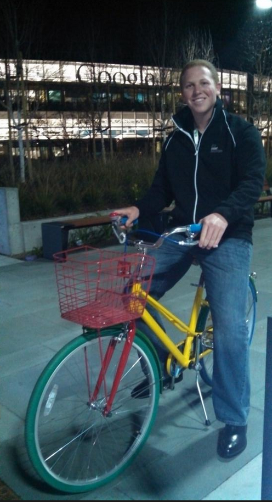 |
| One of the 20under 20 student attendees trying out a Google bike. |
- The students representing 20under20 were amazing, and I want the business teacher and students at our high school to be aware of that foundation and those opportunities
- Edmodo is a well supported social network for students--a network we've tried, and that I'll try again given the fact that it has the backing of many which means that it will probably continue to grow and change. (I'd like to see Edmodo become more like NING).
- PLNs (personal learning communities), intersecting and networking are powerful ways that people learn in our global, information-tech society.
- A good education matters. While people debate education paths for American students, it was clear to me that most of the presenters and innovators at this conference went to what are considered the best schools in the country.
- We must begin to employ tech tools into curriculum where we know those tools can make a significant difference, areas such as ELL, Special Education, math skills, multimedia composition, foreign language learning and more.
Three educators in my PLN, Dan Callahan, Kim Sivick and Steve Hargadon, also attended the event, and it was good to have the chance to discuss the many ideas and innovations presented with them throughout the days.
Please don't hesitate to contact me with fact corrections, important links, further information or questions. As you can see it was an eye-opening, growth producing event for me that gave me many new ideas and perspectives to integrate into the work I do as an educator each day.
Related Articles
News Article
Forbes Article
Gov Tech Article
Huffington Post
Please don't hesitate to contact me with fact corrections, important links, further information or questions. As you can see it was an eye-opening, growth producing event for me that gave me many new ideas and perspectives to integrate into the work I do as an educator each day.
Related Articles
News Article
Forbes Article
Gov Tech Article
Huffington Post
Friday, January 18, 2013
STEAM: Labs, Tools and Play

I am exploring the idea of STEAM labs for elementary schools. My recent post, Full STEAM Ahead, begins the discussion.
Yesterday, I had more time to explore this idea while I played with Sketch-up, a tool that I can imagine becoming part of a STEAM lab as children try to solve problems with design.
As I played around with Sketch-up, I was brought into the learner's mindset. I found myself clicking all the menu bar choices, using trial and error, and exploring the tool with depth. The play reminded me of the fact that we need to give children time to explore tools in their own ways, not just in the ways we decide--a concept many are discussing on the web--one that's been inspired, in part, by Will Richardson's book, Why School?
I was also reminded of the fact that wonderful, new tools change the way we approach and think about design and problem solving. I could have drawn my imagined STEAM lab, but it would have taken me hours to gain the right perspective and revise repeatedly. Instead with Sketch-up, I could simply edit again and again as I played with the notion of a STEAM lab, and I could also easily look at the lab from many perspectives as depicted in the film below. The illustrated lab is still missing integral features--one I couldn't figure out how to draw yet such as windows, greater detail for the cabinets, feature boards (giant touch flat screen computers, cork board and white boards), the outdoor explore area and lab tables.
I welcome your thoughts and ideas as STEAM takes shape. I'm hoping that we'll adopt some aspects of this idea at our grade-level next year, and perhaps this is an idea that will take shape for elementary schools around the country.
Soulard School STEAM Example
Subscribe to:
Posts (Atom)